
Views: 0 Author: Site Editor Publish Time: 2026-06-30 Origin: Site
Sourcing components for commercial HVAC networks leaves zero margin for error. A single failing seal can trigger cascading failures across an entire cooling system. Choosing inferior components often leads to continuous micro-leaks. These leaks cause frustrating technician callbacks and steep drops in system efficiency. Buyers face a tough dilemma today. You must distinguish visually identical commodity parts from precision-engineered components built for intense pressures. You need clear ways to separate robust parts from cheap substitutes. We created this technical evaluation framework to simplify your procurement process. You will learn exactly how to evaluate material integrity and verify critical pressure ratings. You will also discover how to vet suppliers effectively. This guide empowers procurement teams to shortlist a reliable refrigeration access valve without the usual guesswork. Our insights rely on proven industry standards.
Many procurement teams underestimate the financial impact of micro-leaks. Refrigerant loss drains cooling efficiency rapidly. Compressors work harder to maintain temperature setpoints. This extra strain leads to premature mechanical failure. It also exposes organizations to strict EPA compliance risks. Environmental regulations heavily penalize continuous refrigerant venting. System owners face hefty fines if auditors discover persistent leaks.
Poorly manufactured refrigeration spare parts often lack strict dimensional tolerances. This causes immediate operational friction in the field. Technicians frequently encounter stripped threads during basic installations. They end up battling damaged hoses instead of completing tasks efficiently. Dispatching a technician to locate a microscopic leak consumes hours of labor. They must deploy electronic leak detectors. They often apply UV dyes to trace the fault. This diagnostic process costs hundreds of dollars per incident. It severely damages profit margins for service contractors.
We must also evaluate scalability risks. Standardizing on unverified components multiplies these hazards exponentially. A small manufacturing defect becomes a massive liability. You risk compromising fleet-wide installations. Replacing hundreds of faulty valves requires enormous labor investments. It disrupts client operations and damages brand reputation. Building owners also face increased utility bills. The compressor runs constantly to compensate for lost refrigerant. This continuous operation degrades the compressor lifecycle prematurely.
Common Mistake: Procurement teams often focus solely on unit price. They ignore the downstream labor costs associated with replacing failed valves. A cheaper valve quickly becomes the most expensive component on the job site.
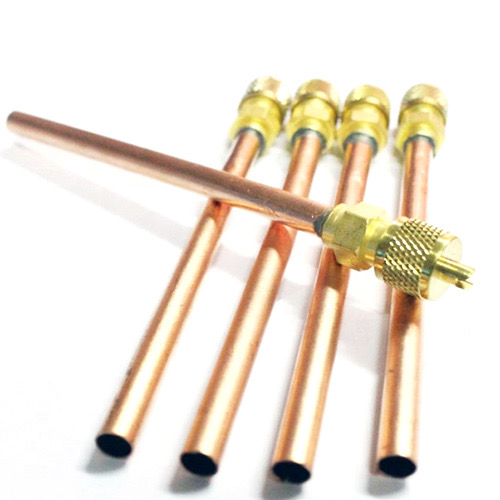
Evaluating raw materials ensures long-lasting mechanical joints. You need a premium copper access valve to achieve seamless brazing. Pure copper tubing prevents microscopic cracking during high-temperature joining. It must bond perfectly to existing copper lines. You should also inspect the brass hex nut carefully. Proper machining tolerances prevent rounding. Technicians apply significant torque during routine service. Soft or poorly extruded brass deforms instantly.
Wall thickness directly controls the ultimate burst pressure. Thin walls fail under constant physical system vibration. They simply cannot handle the intense operating pressures of modern refrigerants. You must verify adequate tube wall thickness. Industry standards demand specific safety margins for high-pressure applications. A robust wall prevents catastrophic ruptures during pressure spikes.
The internal Schrader mechanism dictates overall seal integrity. We must verify O-ring resilience. They must endure extreme temperature fluctuations without hardening. They must also share chemical compatibility alongside the refrigerant. Compressor oils like POE, PAG, and Mineral blends degrade weak rubber fast. Using the wrong seal material causes rapid swelling or shrinkage. This inevitably creates a leak path.
Best Practice: Always specify the exact copper alloy grade for your application. Common alloys like C12200 provide excellent brazing characteristics. You should also inspect the core depressor pin. A poorly machined pin restricts refrigerant flow during charging. It slows down maintenance operations significantly.
| Material Type | Temperature Resistance | Chemical Compatibility | Best Application |
|---|---|---|---|
| Standard Neoprene | Moderate (-20°F to 212°F) | Good for older refrigerants (R-22, Mineral Oil) | Legacy residential systems |
| Nitrile (Buna-N) | Good (-30°F to 250°F) | Compatible with most standard oils | General HVAC/R service |
| Teflon (PTFE) | Excellent (-100°F to 400°F) | High (Compatible with POE/PAG blends) | High-pressure modern refrigerants (R-410A, R-32) |
| EPDM | Excellent (-60°F to 300°F) | Poor compatibility with petroleum oils | Specialized industrial cooling |
Buyers often fall into predictable traps when evaluating technical specs. Manufacturers sometimes use confusing terminology. We identified three common pitfalls you should avoid during procurement.
Field brazing presents unique and difficult thermal challenges. A reliable charging valve must allow fast core removal before brazing. Technicians frequently leave the core inside by mistake. The valve body must withstand intense heat when workers apply heat sinks. Wet rags or thermal gels provide limited protection. The underlying brass and copper must resist warping under extreme torch heat.
Thread compatibility heavily dictates field success. You must ensure 1/4" SAE threading aligns flawlessly. It should fit standard technician manifold gauges perfectly. Consider a rooftop installation in mid-summer. Technicians work under extreme heat and tight deadlines. They rely on their tools fitting perfectly every time. If threads gall or bind, they might force the connection. This ruins the fitting permanently. You prevent this by sourcing valves featuring precision-cut threads. Quality threads ensure smooth engagement.
We must also consider severe environmental exposure. Coastal applications introduce heavy salt spray. Humid environments accelerate galvanic corrosion. You should determine if brass components require specific protective plating. Nickel-plated brass resists harsh outdoor conditions better than raw brass. Always evaluate the final installation environment before approving a component.
Best Practice: Train procurement staff to evaluate knurling patterns on valve caps. Deep knurling allows technicians to tighten caps securely using heavy gloves. Shallow knurling causes slipping and improper sealing.
Selecting a manufacturing partner requires strict and methodical vetting. You must look far past basic product catalogs. We recommend evaluating specific operational metrics before finalizing any air conditioner fittings.
Request full documentation detailing internal testing protocols. You should demand 100% pneumatic testing for all batches. Helium mass spectrometry leak detection provides even greater assurance. Basic water bubble tests miss microscopic leaks entirely. Batch sampling alone leaves too much room for undetected errors. Advanced manufacturers maintain in-house metallurgy labs. They analyze raw copper and brass shipments before production begins. They check for trace impurities. Impurities weaken the final extrusion. You should ask potential partners about incoming material inspection routines. It separates top-tier factories from basic assemblers.
Verify factory certifications thoroughly. Ensure the facility adheres strictly to ISO 9001 quality standards. The raw materials must comply with RoHS guidelines. They should also meet regional HVAC/R safety certifications. Authentic certificates prove the supplier maintains consistent oversight across all production lines.
Evaluate supply chain reliability early in the process. Assess their overall production capacity. Review specific lead times for custom tube lengths. They must prove their ability to deliver consistent metallurgical quality. High-volume orders often expose weaknesses in a supplier's raw material sourcing.
Sourcing the right access valve protects your entire HVAC investment. It remains a relatively low-cost component. However, it carries a disproportionately high risk profile if sourced incorrectly. A single failing seal jeopardizes system efficiency instantly. It drives up maintenance budgets unnecessarily and forces emergency service calls.
Take direct action by updating your procurement standards today. Request material test reports (MTRs) from potential suppliers immediately. Order evaluation samples specifically for destructive testing in your lab. Align your valve specifications directly with your system's exact operating parameters. Prioritizing engineering quality over initial unit cost guarantees long-term system stability.
A: Service valves typically feature internal stems designed to isolate fluid flow completely. This allows technicians to shut off specific system sections. In contrast, standard access valves utilize a Schrader core. This core provides a temporary, secure tap directly into the system for diagnostics or charging without blocking the main line.
A: No. Assuming standard legacy parts will suffice is dangerous. R-32 operates at significantly higher pressures than older refrigerants. You must verify the specific burst pressure rating of the valve. You also need to confirm that internal seals are chemically compatible with R-32 to prevent rapid degradation.
A: The internal Schrader core contains delicate rubber or Teflon seals. These materials have strict thermal limits. Brazing generates intense heat that travels rapidly down the copper tube. If left inside, the seals will melt instantly. This completely compromises the valve's integrity before you even charge the system.

