
Views: 0 Author: Site Editor Publish Time: 2026-08-13 Origin: Site
Installing a ductless mini-split or central AC unit hinges on one critical connection. The refrigerant line literally makes or breaks your entire cooling system. Without a perfect seal, your new equipment simply cannot function. Traditional brazed and field-charged lines demand specialized HVAC tools. Installers rely on vacuum pumps, manifold gauges, and high-heat brazing torches. They also need serious technical skill alongside mandatory EPA certifications. Conversely, a pre-filled alternative offers a streamlined, plug-and-play approach. This appeals heavily to DIY enthusiasts and contractors alike.
However, navigating this market requires absolute caution. Choosing the wrong equipment risks catastrophic refrigerant leaks. You might face premature compressor failure and immediately voided warranties. This guide breaks down the exact technical criteria for evaluating these components. We cover how to guarantee a hermetic seal upon connection. You will learn the industry best practices to achieve optimal system efficiency. By following these steps, you secure long-term reliability for your home cooling investment.
Understanding the baseline differences in installation approaches grounds your buying decision. Every method moves heat out of your home. They just achieve the initial setup very differently. We must define these three primary categories clearly.
Traditional installations represent the industry standard for custom homes and commercial buildings. They require brazing copper pipes together with an oxy-acetylene torch. After brazing, technicians perform high-pressure nitrogen testing to find micro-leaks. They then use a heavy-duty pump to pull a deep vacuum. Finally, they manually weigh and add the exact amount of refrigerant needed. This method carries a high labor cost. It requires extensive tooling and specialized training. However, it offers maximum flexibility. You route the pipes exactly as needed without any leftover slack.
Pre-vacuumed options occupy a middle ground. Factories evacuate all air and moisture from these tubes before sealing them. They do not contain any actual refrigerant inside. Instead, they rely entirely on the AC compressor unit. The outdoor condenser holds a massive pre-charge of refrigerant. Once you connect the pipes and open the king valves, the compressor releases its payload. The refrigerant rushes into the empty, vacuumed pipes. You still bypass the need for a vacuum pump. You do not get the same fail-safe protection as a fully charged system.
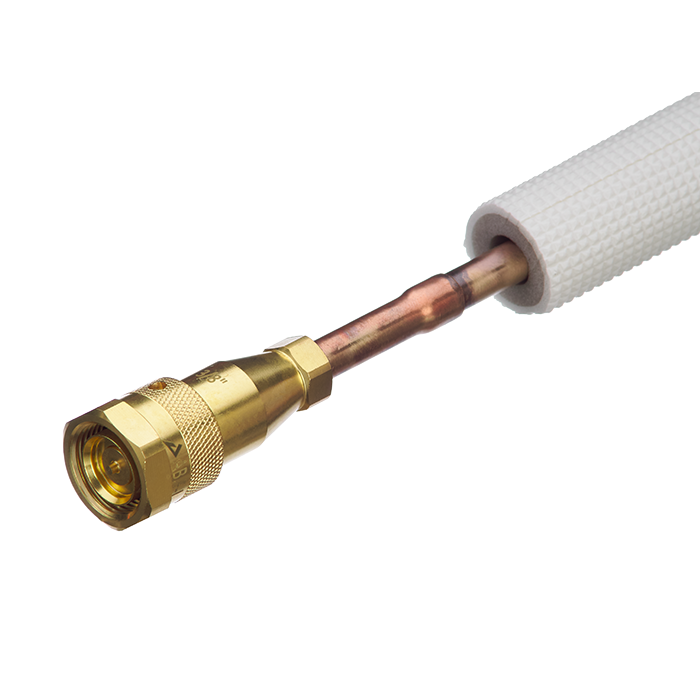
A pre-charged line set ships factory-filled with refrigerant. Manufacturers precisely measure specific refrigerants, usually R-410A, based on the exact length of the tube. These products use specialized breakaway valves. When you tighten the fittings, internal mechanisms puncture a metal diaphragm. This action creates an instant, continuous flow path. You never expose the system to ambient air. You eliminate field vacuuming entirely.
Evaluate the upfront premium of this technology. You pay more for a quick connect line set than raw copper coils. However, you must weigh this against substantial savings elsewhere. You avoid expensive contractor call-out fees. You skip renting heavy vacuum pumps and micron gauges. You reduce installation time from an entire day to just a few hours. For remote cabins or standard residential setups, the math heavily favors the factory-charged approach.
| Installation Type | Tool Requirements | Labor Intensity | Length Flexibility |
|---|---|---|---|
| Traditional Brazed | Torch, Nitrogen, Vacuum Pump, Scale | Very High | Unlimited (Custom) |
| Pre-Vacuumed | Wrenches, Leak Detector | Low | Fixed Length |
| Pre-Charged | Wrenches, Torque Wrench | Very Low | Fixed Length (Cannot Cut) |
Buying the cheapest option often leads to disastrous results. High-pressure refrigerants exploit the smallest material weaknesses. You must evaluate three specific physical dimensions before purchasing.
Modern refrigerants operate under extreme pressure. R-410A easily reaches 400 PSI on a hot summer day. You must source a high-grade AC copper line set to contain this force safely. Look for seamless copper tubing meeting ASTM B280 standards. Wall thickness is critical. Standard lines often feature 0.6mm walls. Premium sets step up to 0.8mm or even 1.0mm thicknesses. Thicker walls prevent accidental kinking during the routing process. They also resist fatigue from constant temperature fluctuations and compressor vibrations.
The quick-connect mechanism serves as the single point of failure. Evaluate this engineering closely. Look for 100% factory-tested, precision-machined brass fittings. The best systems utilize secondary locking mechanisms. They feature self-sealing valves or rupture diaphragms. When you twist them together, they prevent atmospheric contamination. They keep moisture and non-condensable gases completely out of the system. Poorly machined threads will cross-thread easily, ruining the seal and venting your charge into the atmosphere.
Bare copper sweats profusely when cold refrigerant flows through it. Therefore, an insulated refrigerant pipe is mandatory. Look for high-density, closed-cell polyethylene foam. The foam must carry specific certifications. Ensure it offers strong UV resistance for all outdoor sections. The sun will degrade cheap foam into dust within a single year. Furthermore, check for fire-retardant certifications like ASTM E84. Indoor routing through attics and crawlspaces demands fire-safe materials to meet local building codes.
Installation requires precise planning. Factory-sealed tubes introduce rigid constraints into your project. You cannot simply modify them on the fly.
You face one unbreakable rule. A pre-charged line set absolutely cannot be cut. You cannot shorten it. You cannot splice it. Slicing into the copper immediately vents high-pressure refrigerant gas. This violates EPA 608 regulations regarding intentional venting. More importantly, it instantly ruins your equipment. You lose the factory charge, rendering the entire purchase useless. You must accept the fixed length you buy.
Do not simply measure a straight point-to-point line. You must provide a structured framework for your route. Follow these specific steps to calculate your true requirement:
This comprehensive measurement often reveals you need a 25-foot set rather than a 16-foot set. Always round up to the nearest available factory length.
Because you must round up, you will inevitably have leftover line. Dealing with this excess defines a professional-looking installation. You must coil the extra tubing. However, orientation matters immensely. You must coil the excess line horizontally. Lay the loops flat on the ground behind the condenser. Never coil them vertically like a garden hose on a wall. Vertical loops create dangerous oil traps. Compressor lubricating oil travels through the lines alongside the refrigerant gas. If you create vertical loops, oil pools at the bottom of each circle. It cannot overcome gravity to return to the compressor. The compressor eventually runs dry, overheats, and seizes permanently.
Even the finest copper tubing fails if it does not match your specific machinery. You must align your purchase with your hardware's exact specifications.
HVAC systems use dual pipes. The smaller liquid line carries condensed refrigerant indoors. The larger suction line returns gaseous refrigerant outdoors. These diameters directly correlate to the tonnage and BTU output of your unit. A standard 9,000 to 12,000 BTU mini-split usually requires 1/4" and 3/8" lines. If you step up to a 24,000 BTU unit, you likely need 3/8" and 5/8" lines. Connecting undersized lines restricts flow. It starves the evaporator coil and freezes the system. Connecting oversized lines reduces gas velocity. This prevents proper oil return. You must check your specific condenser's manual for exact sizing requirements.
The market offers both universal and proprietary connection types. Universal kits fit a wide variety of budget-friendly brands. However, premium HVAC manufacturers often use proprietary thread pitches. They mandate specific connector depths. Attempting to force an off-brand connector onto a proprietary valve shreds the brass threads. Some manufacturers even mandate the use of their own branded quick-connect systems. They do this to guarantee the integrity of the initial seal.
Integrating a third-party air conditioner installation kit carries warranty implications. Many major brands state their warranty remains valid only if a licensed contractor installs the equipment. Others permit DIY installations but require proof of a professional vacuum and charge. Utilizing self-sealing technology often bypasses the need for a contractor. However, you must carefully read your equipment's warranty packet. Verify compliance before purchase. Look for explicit clauses regarding "factory-charged line allowances" or "DIY series" approvals.
You now possess the technical knowledge to evaluate these products. You must apply this logic to your specific project environment.
This path works best for dedicated DIYers installing single-zone mini-splits. It proves invaluable for remote cabins located far from urban centers. It excels in scenarios where HVAC contractor availability remains critically low. If your line run is standard, uncomplicated, and measures under 50 feet, this is your best option. You gain massive convenience without sacrificing system performance. The upfront premium pays for itself by eliminating labor costs.
You must abandon the plug-and-play approach for complex installations. Multi-zone routing to four different rooms requires customized lengths. If your run exceeds the maximum pre-charged length limit—usually around 50 feet—you need field charging. Finally, consider aesthetics. If you require precise, tight routing along exterior siding, you have no room for coiled excess lines. A traditional brazed installation guarantees zero leftover slack.
Selecting the right connection involves precise measurement and rigorous material evaluation. You cannot afford to guess when dealing with high-pressure systems. Verify the wall thickness of the copper. Confirm the UV resistance of the foam. Ensure your diameters match your unit's BTU output perfectly.
These factory-sealed systems offer undeniable conveniences. They provide massive time and labor savings for residential projects. However, their rigid length constraints demand strict adherence to routing rules. You must master horizontal coiling best practices. Prioritize high-quality materials and factory-tested connectors over unverified budget alternatives. Doing so protects the lifespan of your compressor. It ensures your home remains perfectly cool for years to come.
A: No. Cutting the line instantly vents the factory-loaded refrigerant into the atmosphere. This ruins the equipment, violates EPA regulations, and completely destroys the system's ability to cool. You must safely coil any excess length horizontally.
A: True pre-charged sets bypass the vacuum step entirely. The sealed connectors prevent air from entering during installation. However, if you purchase a pre-vacuumed set without internal refrigerant, you still follow specific release protocols, though a pump remains unnecessary.
A: No. The internal diaphragms and breakaway seals are single-use mechanisms. Once punctured during the initial installation, they cannot be resealed. Moving the unit requires a professional to recover the refrigerant and install fresh lines.
A: A kink severely restricts refrigerant flow and oil return. This forces the compressor to work harder, eventually leading to overheating and mechanical failure. Because you cannot cut or braze a charged line, a kinked set must usually be entirely replaced.


