
Views: 0 Author: Site Editor Publish Time: 2026-11-02 Origin: Site
A failing plumbing connection presents immediate, severe risks to your property. You might face catastrophic water damage overnight. You could experience unexpected operational downtime in a commercial setting. You might even incur massive mold remediation bills. Copper piping itself often lasts for several decades without issue. However, the fittings and connections remain the primary points of failure. They constantly endure intense chemical, thermal, and mechanical stress. Our goal in this article is very clear. We provide an evidence-based framework to help you diagnose these connection failures accurately. You will learn how to evaluate the most reliable repair methods available today. We base these structural evaluations on application suitability, strict building code compliance, and long-term viability. By understanding these concepts, you can protect your plumbing infrastructure permanently.
Acidic flux residue causes immense damage to plumbing systems over time. Installers wipe flux onto pipes before soldering. It cleans the metal surface perfectly. However, excess flux becomes highly corrosive. It sits on the pipe exterior and turns into a green crust. This chemical slowly eats through the metal wall. Eventually, it creates a tiny pinhole leak. Galvanic corrosion is another major plumbing threat. It happens when dissimilar metals touch directly. Sometimes installers connect galvanized steel directly to copper. They forget to install a proper dielectric union. This oversight creates a tiny electrical current. The current accelerates rust and metal decay rapidly. Hard water also damages pipes from the inside. High mineral content acts like liquid sandpaper. It strips away the inner protective layer.
Thermal expansion heavily impacts rigid plumbing runs. Hot water makes metal pipes expand outward. Cold water makes them contract inward. Without proper expansion loops, this constant movement stresses every connection point. Over several years, it slowly pulls fittings apart. Water hammer represents another massive mechanical threat. Fast-closing valves cause violent hydraulic shock. The rushing water stops instantly. This sends kinetic shockwaves back through the system. You usually hear a loud banging noise behind the walls. This violent force fractures rigid connections. It creates micro-fractures in the surrounding metal.
Proper heat application is vital for permanent plumbing connections. A plumber must heat the fitting, not the solder itself. If they use inadequate heat during installation, the solder will not flow properly. It merely melts and sits on the surface. This creates a weak, brittle bond. Plumbers call this a cold solder. Over time, normal water pressure breaks this fragile seal. The connection fails completely. A poorly heated Copper pipe joint might look fine on the outside. However, it lacks the deep internal capillary bond required to hold water pressure for decades.
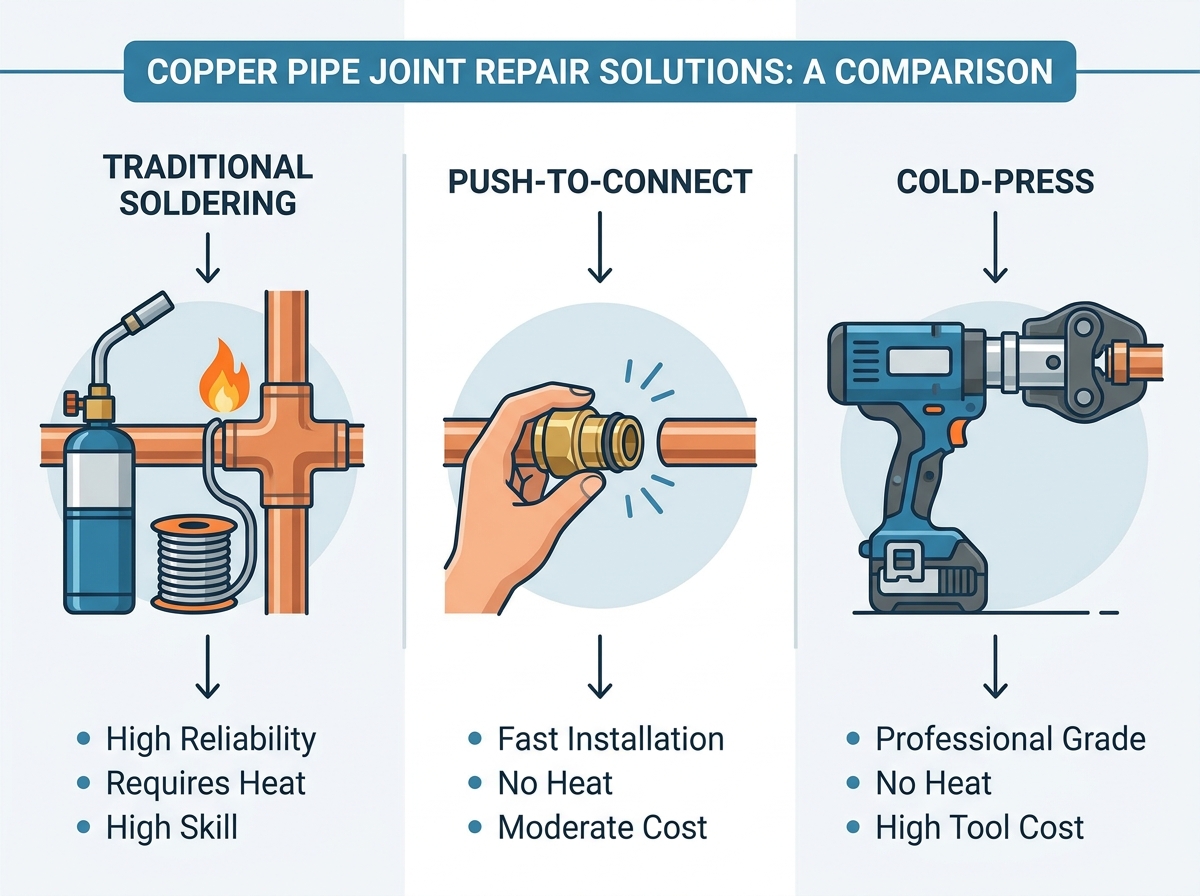
Traditional soldering relies on basic capillary action. You heat the fitting with a torch. The heat draws molten lead-free solder deep into the gap. This method offers the highest long-term reliability. Material costs are incredibly low. You only need basic solder and flux paste. However, soldering requires a high technical skill level. You also face serious fire risks when working in confined spaces. We recommend keeping a fire extinguisher nearby. Furthermore, this method requires a completely dry pipe. Solder will absolutely not flow if water sits inside the line.
Push-to-connect fittings provide incredible speed. They utilize an internal O-ring seal to stop water. Stainless steel gripping teeth grab the pipe exterior tightly. You experience very fast installation times. You need no heat or special crimping tools. You can even install them on wet lines during emergencies. However, they come with notable trade-offs. They have a much higher unit cost. Plumbers still fiercely debate their decades-long reliability behind closed walls. They also feature a bulkier profile. This makes them hard to fit in very tight wall cavities.
Cold-press technology dominates modern commercial plumbing. You use a mechanical pressing tool to crimp the fitting. The jaws crush an internal O-ring tightly against the pipe. It offers professional-grade reliability. The process is incredibly fast and completely heat-free. You eliminate all fire risks instantly. The connections handle massive water pressure easily. The primary trade-off is the prohibitive tool cost. A commercial press tool costs thousands of dollars. This makes it impractical for simple one-off DIY home repairs.
Emergency interventions buy you valuable time. You can use curing resin putties to patch small holes. You can also apply rubber-lined metal pipe clamps over cracks. You just tighten the bolts to compress the rubber. However, these are strictly temporary fixes. They only stop active leaks temporarily. They hold the water back until you execute a permanent repair. You must never use them on high-pressure main lines. They will fail suddenly under constant structural stress.
Technical Comparison of Plumbing Repair Methods
| Repair Method | Primary Mechanism | Reliability Level | Best Use Case |
|---|---|---|---|
| Traditional Soldering | Capillary action | Excellent | Exposed pipes, permanent hidden repairs |
| Push-to-Connect | O-ring and steel teeth | Good | Quick access repairs, wet pipe emergencies |
| Cold-Press Fittings | Mechanical crimp | Excellent | Commercial sites, large residential projects |
| Mechanical Clamps | Rubber compression | Poor (Temporary) | Stopping active leaks before repiping |
You must completely isolate the affected system first. Highlight the absolute necessity of shutting off the main water supply immediately. You must then open the lowest faucets in the building. This bleeds the lines of standing water. If you skip this step, water remains trapped inside. Expert insight confirms a crucial physical reality. Solder will absolutely not flow if steam is present in a newly cleaned Copper pipe joint. The steam creates internal pressure. It pushes the molten metal back out of the fitting.
Surface preparation separates amateur work from professional results. You must follow strict abrasive cleaning standards. Grab some quality emery cloth or a stiff wire brush. Scrub the pipe exterior vigorously. You must clean it down to bare, shiny metal. You must remove all dark oxidation and old paint. This requirement remains true regardless of your repair method. Soldering needs clean metal to bond. Push-fittings need a smooth surface. A dirty pipe exterior will easily tear the internal rubber O-ring.
Building codes dictate your allowable repair methods. You must always address building code nuances before opening walls. Many local jurisdictions enforce strict placement restrictions. For example, some codes prohibit mechanical push fittings in inaccessible locations. You cannot bury them behind drywall forever. You also cannot bury them underground. Solder and press fittings usually pass inspection everywhere. Always consult your local municipal guidelines. Failing a plumbing inspection forces you to tear open walls and redo the work.
Spot repairs save you significant time and money. You should execute a spot repair under specific conditions. First, confirm you have an isolated failure. Only one fitting should show damage. Second, ensure the location is fully accessible. Basements and unfinished utility rooms are perfect candidates. Third, look closely at the metal surface. You should only see localized external corrosion. The rest of the pipe network must look clean and structurally sound.
Sometimes a single leak indicates systemic system failure. You must call a professional under dangerous conditions. Main water service line leaks require heavy equipment and permits. You should also look for evidence of systemic inner-pipe pitting. If you see heavy blue or green scaling throughout the entire system, stop immediately. Your pipes are rotting from the inside out. Spot repairs will not save them. Additionally, if you find leaks near electrical panels or HVAC units, call a licensed contractor. Water and high voltage create fatal risks.
You can quickly determine your best path forward. Follow this simple logic tree to shortlist your ideal solution:
Addressing a failing connection is not just about stopping immediate water flow. It is fundamentally about restoring the mechanical integrity of your plumbing system. Temporary patches will eventually fail. You must evaluate your own technical comfort level honestly. You must also consider the specific placement of the leak before purchasing materials or tearing open walls. Do not take unnecessary risks around electrical panels. We highly prompt you to source high-quality, code-compliant fittings for any permanent fix. If you feel unsure, consult with a licensed plumbing contractor. Professional help prevents catastrophic floods during high-risk main line repairs.
A: No permanent fix can be applied under active pressure. Only temporary mechanical clamps can be used on active leaks as an emergency stop-gap.
A: Typically due to repeated physical stress from water hammer, lack of proper pipe hangers/support, or a poorly executed initial solder.
A: Push-fit connections are highly reliable and code-approved in many jurisdictions, but traditional soldering remains the gold standard for permanence, especially in concealed spaces.
A: It should be treated as a temporary measure (days to weeks) to mitigate damage until the section of pipe can be cut out and properly replaced.


