
Views: 0 Author: Site Editor Publish Time: 2026-10-26 Origin: Site
In commercial and high-performance residential plumbing, system failures rarely start in the pipes themselves. They almost always occur at the connection points. Weak joints cause devastating leaks. They lead to expensive structural water damage. You need reliable connections to maintain optimal flow rates safely. Inferior materials create unseen bottlenecks. They silently compromise your entire fluid network over time. Manufacturers now produce modern components using an advanced hot forging process rather than traditional sand casting. This exact method shapes solid metal billets under extreme heat and heavy mechanical pressure. The resulting density far exceeds older cast components. Choosing Hot punch brass fittings represents a highly strategic decision for building professionals. It directly impacts your installation speed. It ensures long-term system pressure integrity. It dramatically reduces future maintenance needs. Understanding this crucial manufacturing difference helps you build significantly better infrastructure.
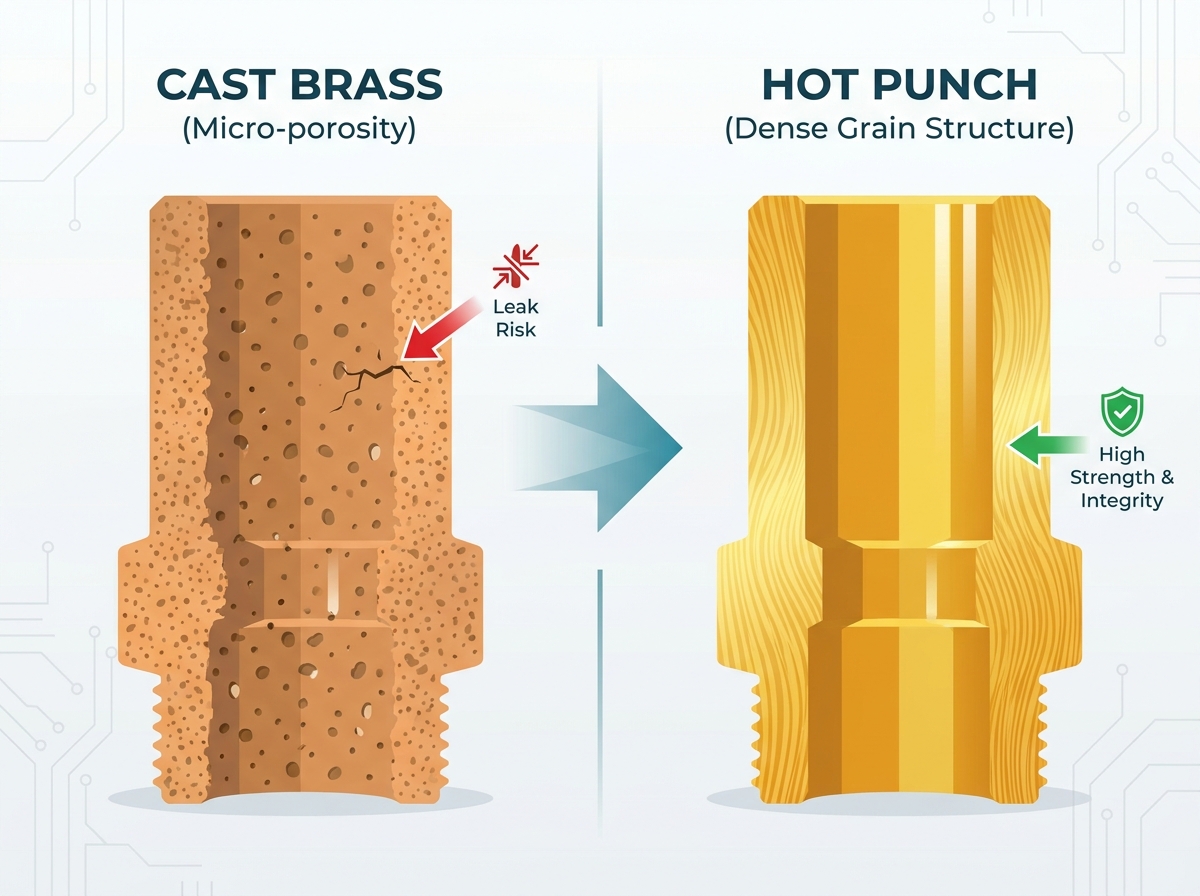
Traditional sand-cast brass frequently contains microscopic air pockets. Engineers call this inherent defect internal porosity. These hidden voids silently compromise high-pressure fluid systems over time. Constant water pressure cycling eventually exposes these hidden weak spots. Micro-fractures grow along the porous pathways inside the metal. This deterioration inevitably leads to catastrophic joint failure. Building owners often discover these leaks long after they start.
The hot punching process solves this structural flaw completely. Factories heat solid brass billets until they reach a highly malleable state. Heavy mechanical presses then stamp them into precise steel dies under extreme tonnage. The metal flows into every corner of the mold flawlessly. We see no trapped gases or air pockets.
This intense physical pressure perfectly aligns the metal grain structure. It yields a significantly higher yield strength compared to poured metal. You get a denser, highly uniform metallic body. This superior density effectively reduces the long-term failure rate. Installers no longer worry about invisible pinhole leaks forming over time. The risk of weeping joints inside finished walls drops effectively to zero. We highly recommend specifying these forged components for critical commercial infrastructure. The baseline reliability simply outperforms traditional manufacturing methods.
The incredible precision of hot-punched dies creates exceptionally smooth internal walls. Sand casting always leaves a rough, uneven interior texture. Smooth walls directly reduce fluid turbulence inside the pipe network. They minimize harmful pressure drops across complex HVAC configurations. Pumps use significantly less electrical energy to push water through the lines. This directly boosts overall system efficiency.
Fluid dynamics dictate how friction slows down water velocity. A smoother surface mathematically lowers the friction coefficient. Engineers appreciate this highly predictable performance metric. System designers can specify smaller pumps safely. Less resistance means better flow rates at every terminal unit. Hot punch brass fittings actively contribute to green building energy goals. The cumulative energy savings across a large facility add up quickly.
These dense components handle extreme temperature fluctuations beautifully. Commercial hot water lines demand high thermal resilience. Chiller systems also subject materials to intense thermal stress. Rapid expansion and contraction will easily crack lesser, porous materials. The uniform grain structure actively resists thermal fatigue. Hot punch brass fittings maintain perfect joint integrity even under heavy thermal cycling. They perform reliably in both freezing and boiling conditions.
We also must assess surface corrosion resistance carefully. Humid environments accelerate aggressive surface oxidation. High-density forged surfaces resist this degradation better than cast alternatives. Porous metals allow moisture to penetrate deeper into the component wall. Forged metal creates a solid barrier against environmental humidity. You can deploy them safely in coastal properties or damp basements. They provide peace of mind in challenging environmental scenarios.
Modern plumbing networks rarely use a single uniform pipe material. Installers frequently blend PEX, rigid copper tubing, and specialized polymers. We need reliable parts to bridge these distinct zones. Forged brass serves as the absolute ideal transition material. It bridges these different systems securely and safely. It acts as the universal adapter in modern construction projects.
Mating brass to cross-linked polyethylene (PEX) requires highly specific mechanical profiles. Installers primarily use either copper crimp rings or cold expansion tools. The tight dimensional tolerances of punched brass ensure a secure fit. The machined barbs grab the internal plastic tubing perfectly. This precise interaction prevents dangerous blowouts under heavy water pressure.
Cold expansion techniques stretch the PEX tubing temporarily. The tubing then shrinks back tightly over the brass fitting. If the fitting diameter varies slightly, the joint will leak. Hot forging guarantees exact external diameters every time. You avoid the frustrating inconsistencies commonly found in cheaper cast batches.
High dimensional accuracy pairs flawlessly with modern press-tool systems. Clean, fast, flame-free pressing connections have totally transformed the plumbing industry. Traditional soldering requires dangerous open flames. It utilizes messy, toxic flux pastes. It demands strict, expensive fire watches on commercial jobs. Pressing eliminates these safety hazards entirely.
The mechanical pressing tool depends completely on exact outer fitting dimensions. The hot forging process guarantees this precise sizing reliably. A secure O-ring seal relies entirely on this manufacturing consistency. The jaws of the press tool crush the fitting around the pipe uniformly. If the brass is out of round, the seal fails. Forged brass eliminates this particular installation failure mode. It allows crews to move incredibly fast.
We must warn you against improper material integration. Joining brass directly to incompatible metals causes severe galvanic corrosion. Galvanized steel represents a major risk factor in older commercial buildings. The resulting chemical reaction rapidly degrades the connection joint. The less noble metal sacrifices itself and crumbles away into rust. You compromise the structural integrity of the entire water line.
You must always use proper dielectric unions when crossing distinct metal families. This simple isolation step prevents catastrophic joint failure. It physically separates the competing metals. It stops the electrical current driving the corrosion process. Plumbers often ignore this step to save time. We consider this a costly installation mistake. Protect your infrastructure investment proactively.
Environmental factors significantly influence installation success. Freezing conditions often spark fierce debates among field contractors. Many wonder if they should warm brass fittings before clamping PEX tubing. Let us clarify the technical reality of winter installations. Cold weather naturally makes PEX tubing extremely rigid. The plastic becomes difficult to bend, cut, and handle properly.
You might need to gently warm the plastic pipe. However, the brass component itself generally requires zero heating. Heating the brass offers no mechanical advantage. We always advise checking verifiable manufacturer guidelines carefully. Avoid relying on anecdotal job-site advice. Follow the published cold-weather procedures strictly. This ensures your warranty remains fully intact.
Selecting a reliable supplier demands a clear and strict framework. You should systematically evaluate several key performance indicators. First, always verify necessary health certifications. Second, scrutinize the specific alloy chemistry. Third, demand proof of strict dimensional control. We strongly recommend implementing a standardized review process. Do not purchase based solely on initial catalog availability.
Always verify NSF/ANSI 61 and 372 standards. These specific certifications ensure strict lead-free compliance. Potable water applications legally require these health safety marks. Building inspectors will reject uncertified materials immediately. You cannot risk project delays due to non-compliant components. Ask your manufacturer for updated compliance documentation annually.
Check for Dezincification Resistant (DZR) brass alloys. Highly aggressive local water supplies will leach zinc from standard brass. This harmful process leaves behind a weak, porous copper shell. The fitting will eventually snap under normal stress. DZR materials actively prevent this destructive chemical process. They alter the alloy microstructure to lock the zinc in place. They represent mandatory upgrades in regions facing poor water quality.
Ensure your manufacturer guarantees exceptionally tight tolerances. They must suit your intended connection method perfectly. Press, thread, and push-to-connect systems all require exact dimensions. A fraction of a millimeter determines whether a joint holds or leaks. Ask for factory quality control reports. Understand how they measure and verify their product batches before shipping.
| Evaluation Criteria | Sand Cast Brass Alternative | Hot Punched Forged Brass |
|---|---|---|
| Structural Density | Prone to internal air porosity | Highly dense, uniform grain structure |
| Dimensional Accuracy | Inconsistent wall thickness | Exact tolerances suitable for press tools |
| Flow Efficiency | Rough interior creates turbulence | Smooth interior minimizes pressure drop |
| Tensile Strength | Lower resistance to pressure spikes | High resilience against thermal fatigue |
System efficiency results from a careful combination of critical factors. Unimpeded water flow matters immensely. Reliable leak prevention remains paramount. Rapid installation speed keeps projects securely on schedule. Superior manufacturing directly delivers these essential benefits. Hot punch brass fittings eliminate the hidden risks associated with older sand-cast methods.
We strongly advise decision-makers to audit their current plumbing failure points. Identify where previous weak connections have failed your facilities. Consider how the exceptional reliability of hot-forged components mitigates future operational risks. Specify better materials for your next commercial project confidently. Elevate your baseline engineering standards today. You will reap the rewards of lower maintenance demands.
A: You can easily identify them by examining their surface finish. Forged components typically feel much smoother and feature distinct, clean forge-parting lines. Cast alternatives usually display a rougher, sandy texture across their exterior surface due to the manufacturing mold material.
A: Yes, but you must select the right alloy. While their dense structure limits deep internal corrosion, standard brass can still tarnish externally. We recommend specifying Dezincification Resistant (DZR) alloys or applying specific surface treatments to protect joints in extreme humidity.
A: They absolutely do. Pressing tools rely entirely on exact outer dimensions to create a mechanical seal. Hot forging provides superior dimensional consistency over sand casting. This exact sizing ensures the internal O-ring compresses perfectly for a secure, leak-free joint.
A: No, you generally do not need to heat the brass. PEX tubing becomes rigid in freezing temperatures and may require careful handling or gentle warming. The brass component itself remains completely stable. Always defer to the specific cold-weather installation specs provided by the PEX manufacturer.


