
Views: 0 Author: Site Editor Publish Time: 2026-09-23 Origin: Site
Every HVACR system relies on precise engineering to maintain thermal transfer and pressure integrity. At the heart of this continuous cycle, the refrigeration copper U bend plays a critical role in closing loops within heat exchangers, condensers, and evaporators. Selecting the wrong fitting carries severe operational and business risks. You face system leaks, catastrophic pressure failures, and expensive refrigerant loss. Substandard bends also cause inefficient flow, which forces compressors to work much harder and degrades overall system performance.
In modern high-pressure cooling setups, these risks are completely unacceptable. This article provides a verifiable, specification-driven framework for evaluating and sourcing these critical components. We will explore material standards, precise sizing requirements, and essential testing protocols. Procurement managers and HVACR engineers will learn exactly how to qualify manufacturers and guarantee long-term system reliability.
Procurement teams sometimes treat pipe fittings as simple commodities. This mindset leads to significant downstream failures. Evaluating the true impact of poor fittings reveals why stringent selection matters.
Fluid dynamics play a crucial role inside a condenser coil. Incorrect centerline radius (CLR) disrupts smooth refrigerant flow. Tight or crimped bends create heavy internal turbulence. This turbulence increases resistance as the gas or liquid navigates the curve. Compressors must work harder to push mass flow through restricted pathways. Consequently, your system experiences a noticeable drop in its overall Coefficient of Performance (COP). Engineers must prioritize aerodynamic sweep designs to maintain optimal fluid velocity.
Refrigeration systems generate continuous harmonic vibration. Compressors emit pulsing discharge forces through the entire piping network. The system essentially acts like a large tuning fork. Thin-walled or poorly annealed fittings absorb this kinetic energy poorly. They become the primary locations for micro-fracture failures. Proper annealing processes soften the copper. This allows it to flex slightly and absorb harmonic stress without snapping. Hard-drawn or improperly heated ends succumb rapidly to brittleness.
Substandard brazing joints often result from poor dimensional tolerances on the leg lengths. If the legs do not align perfectly parallel, installers must force them into the coil block. This introduces physical stress before the system even powers on. Over time, these stressed joints crack. Refrigerant leaks create immense financial and environmental liabilities. Replacing lost gas is incredibly expensive today. Furthermore, sudden system downtime halts commercial operations, damages temperature-sensitive inventory, and ruins brand reputation.
Standard building materials cannot withstand the rigors of mechanical cooling cycles. You must enforce strict metallurgical and cleanliness standards during the procurement phase.
You must specify C12200 (DHP - Deoxidized High Phosphorus) copper. This specific alloy provides optimal thermal conductivity for heat exchange applications. More importantly, the high phosphorus content actively prevents hydrogen embrittlement. During high-temperature silver brazing, standard oxygen-bearing copper reacts violently. It forms microscopic steam pockets inside the metal. These internal voids weaken the joint structure. C12200 eliminates this risk entirely, ensuring strong, leak-proof connections.
Never substitute standard plumbing copper for refrigeration tasks. Plumbing pipes handle low-pressure water. Refrigeration circuits handle high-pressure volatile gases. You must require adherence to ACR standards. An acceptable ACR copper U-bend follows ASTM B280 guidelines for field service applications. For seamless tube manufacturing requirements, rely on the ASTM B75 specification. These frameworks guarantee precise metallurgical purity and grain structure.
Internal cleanliness remains absolutely non-negotiable. Manufacturing processes use heavy drawing oils to shape the metal. If factories leave these oils inside the tube, disaster follows.
Define a strict baseline expectation. Suppliers must ship all fittings nitrogen-purged. They must also install tight-fitting end caps immediately after cleaning. These caps block oxidation and moisture intrusion prior to final installation.
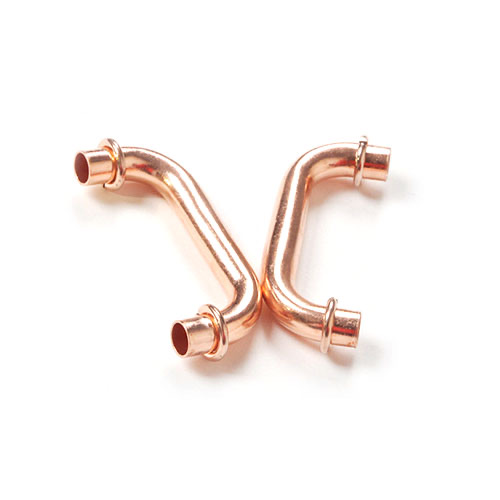
Dimensional accuracy separates premium fittings from failure-prone alternatives. Exact geometric sizing determines both assembly speed and long-term durability.
Exact OD sizing remains vital for assembly line efficiency. The fitting must mate perfectly with the straight tubing of the coil block. Silver brazing relies entirely on capillary action. Heat draws the liquid braze alloy into the joint against gravity. Capillary action requires a precise gap, typically between 0.002 and 0.005 inches. If the OD is too small, the gap becomes too wide, and the solder simply drips away. If the OD is too large, the installer cannot fit the pieces together.
Engineers must match wall thickness to peak operating pressures. You cannot rely on the starting thickness alone. The manufacturing process bends the straight tube around a die. This action physically stretches the metal on the extrados (the outside curve of the bend). A tube starting at 0.030 inches might thin down to 0.024 inches at the apex. You must demand thicker starting stock to compensate for this extrados thinning, especially for high-pressure systems.
Table 1: Typical Extrados Thinning Allowances
| Refrigerant Type | Operating Pressure range (psi) | Required Starting Wall Margin (Above Target) |
|---|---|---|
| R-134a (Legacy) | Low to Medium | +10% |
| R-410A / R-32 | High | +15% to 20% |
| R-744 (CO2 Transcritical) | Ultra-High (>1400 psi) | +30% (or specialized high-strength alloys) |
Designing the CLR requires a careful balancing act. Fluid dynamics dictate an aerodynamic need for a wide sweep. Wider sweeps dramatically reduce internal pressure drop. However, physical footprint constraints often dictate otherwise. Modern compact condenser coils demand tight spacing to save room. Engineers must optimize the CLR to fit the coil block pitch while avoiding crimping or kinking the inner radius.
The HVACR industry continues moving toward more environmentally friendly, yet higher-pressure, refrigerants. Your component specifications must evolve accordingly.
Decades ago, systems utilized R-22, which operated at relatively low pressures. Standard fittings handled these stresses easily. Today, the landscape looks drastically different. Systems utilize R-410A and R-32, which run at significantly higher pressures. Furthermore, the industry is rapidly adopting ultra-high-pressure natural refrigerants like R-744 (CO2). Transcritical CO2 systems operate at pressures that will easily rupture standard legacy piping.
Calculating required burst pressure margins is essential for safety. Do not rely on theoretical tube charts provided by basic metal distributors. Demand empirical burst test data directly from the manufacturer. A reliable burst testing protocol involves:
Applications like deep-freeze storage or commercial heat-pumps experience drastic temperature swings. Metal expands when heated and contracts when frozen. These continuous cycles cause thermal fatigue. High-quality annealing processes refine the copper grain structure. This refinement allows the fitting to endure decades of thermal expansion without developing fatigue cracks.
Finding a supplier who simply bends copper is easy. Finding a partner who consistently meets strict ACR tolerances requires rigorous auditing.
Always advise your buying team to request detailed data on ovality (roundness) and leg length tolerances. Bending metal naturally attempts to flatten the tube. Premium manufacturers use internal mandrels to keep the tube perfectly round. Out-of-round ends require manual resizing on the factory floor. This extra step completely destroys assembly line efficiency and increases labor costs.
Look for ISO 9001 certification as a baseline. Beyond that, evaluate their batch traceability systems. If a fitting splits during installation, can the manufacturer trace that exact piece back to the original raw copper billet? Proper traceability proves they control their supply chain and take accountability for metallurgical defects.
Coil designs vary wildly across different OEM brands. The pitch (distance between the two legs) changes based on fin design and tube routing. Assess if the supplier possesses in-house tooling capabilities to accommodate custom pitch requirements. In-house tooling prevents exorbitant Non-Recurring Engineering (NRE) fees and drastically shortens lead times for new product development.
Never commit to high-volume procurement based on a brochure. Recommend requesting sample batches for destructive testing first. Perform your own burst tests. Section the bends in half to measure the actual extrados wall thickness under a microscope. Conduct braze-ability trials on your assembly line to verify the OD tolerances. Only issue purchase orders once the samples pass these physical trials.
Saving fractions of a cent on a fitting is a dangerous false economy. When you weigh minor upfront savings against the staggering costs of warranty claims, system leaks, and compressor failures, the choice becomes clear. High-quality manufacturing protects your final product.
To ensure reliability, follow a strict final checklist. Verify compliance with ASTM standards. Calculate and check wall thickness allowances for your target refrigerants, especially compensating for extrados thinning. Finally, demand strict internal cleanliness, requiring nitrogen purging and secure end caps on all shipments.
Take action today to secure your supply chain. Consult with an engineering specialist regarding your specific coil designs. Request a comprehensive technical specification sheet and physical samples from a qualified, traceable manufacturer to begin your quality validation process.
A: Standard plumbing pipe handles low-pressure water and lacks strict cleanliness controls. ACR variants adhere to ASTM B280 or B75 standards. They require exact dimensional tolerances for high-pressure gases. Furthermore, ACR fittings are meticulously degreased, nitrogen-purged, and capped to prevent internal oxidation and moisture contamination.
A: Bending a tube mechanically stretches the metal on the outer radius (extrados). This stretching causes the wall to thin significantly. If the starting tube is too thin, the apex becomes a weak point prone to bursting under high pressure. Manufacturers must use appropriately thick-walled starting tubing to compensate.
A: Transcritical CO2 systems operate at extreme pressures, often exceeding 1400 psi. Standard wall thicknesses will rupture. These systems necessitate significantly heavier wall thicknesses, often requiring up to a 30% margin over standard R-410A tubes. Many engineers specify specialized high-strength copper-iron alloys to handle these extreme stresses safely.
A: Braze failures typically stem from three issues. Poor ovality (out-of-round ends) ruins the capillary gap needed for silver solder. Improper leg spacing forces installers to bend the legs, causing physical stress fractures. Finally, internal oxidation from a lack of nitrogen purging during manufacturing or installation prevents the braze from adhering properly.


