
Views: 0 Author: Site Editor Publish Time: 2026-10-30 Origin: Site
A failed connection behind drywall or under a concrete slab is a catastrophic expense. Selecting the right joint type is not just a casual preference. It represents a critical calculation of risk, labor hours, and local code compliance. The plumbing and HVAC industries have shifted heavily over the last decade. Traditional sweating remains a staple in many shops today. However, mechanical pressing and cold-joining technologies have disrupted standard operational procedures. Contractors now face intense pressure to accelerate project timelines safely. You must balance upfront material expenses against skilled labor shortages. This guide breaks down the core joining methods by application, implementation realities, and long-term reliability. We will help you specify the exact connection type for your next build, repair, or commercial rollout. Read on to master these criteria and protect your bottom line.
Before selecting a connection method, you must define the precise engineering parameters. System media and internal pressure establish your baseline requirements. Establish exactly what the pipe will carry first. Will it transport potable drinking water, volatile natural gas, compressed air, or high-pressure refrigerant? Identify the required PSI and temperature thresholds carefully. Residential water systems typically operate between 40 and 80 PSI. Commercial HVAC refrigerant lines can easily exceed 400 PSI. These massive pressure differences dictate the mechanical strength required from your connection.
Environmental and site constraints heavily influence your overall installation strategy. Evaluate the physical workspace thoroughly before beginning work. Hot work involves soldering or brazing near combustible materials. Performing hot work in occupied buildings or confined spaces carries immense risk. It frequently triggers costly fire-watch protocols. Safety regulations might require a dedicated fire-watch guard for hours after completion. These hidden labor expenses drain project budgets rapidly.
Code compliance and industry certifications are entirely non-negotiable for professionals. You must highlight the strict necessity of checking local IPC or UPC codes. Ensure all plumbing fittings meet NSF/ANSI 61 standards for drinking water safety. ASME standards strictly dictate the requirements for pressure vessels and high-stress lines. Inspectors will fail non-compliant materials instantly. A failed inspection ruins profit margins and deeply damages your professional reputation.
Finally, acknowledge the frustrating wet-line reality on most job sites. Plumbers rarely work on completely dry, brand-new systems. You constantly face the implementation hurdle of repairing existing networks. Draining large commercial lines completely is sometimes physically impossible. Residual water turns to rapid steam during thermal joining. This steam blows out the molten solder instantly. This reality strongly favors mechanical joints over traditional thermal applications. Mechanical presses work flawlessly even on actively dripping pipes.
Soldering, commonly called sweating, is a time-tested thermal technique. The mechanism relies entirely on natural capillary action. Installers use an acidic flux paste and a lower-temperature filler metal. You heat the fitting until the alloy melts completely. The liquid metal flows upward into the tight joint gap. This action seals the connection at a permanent molecular level.
This traditional method is best for very specific scenarios. We use it frequently for cost-sensitive residential potable water lines. It also works perfectly for low-pressure hydronic heating loops. The base materials cost mere pennies per joint. It remains the most economical material choice available today.
However, the modern implementation risk is substantial. Success is highly dependent on dedicated operator skill. The technique requires absolutely bone-dry pipes to succeed. It also carries a significant fire risk during the installation process. Careless torch handling ignites wooden studs very easily.
Brazing takes thermal joining to a much higher temperature spectrum. The mechanism uses high-temperature oxy-acetylene torches. Installers utilize silver or phosphorus filler metals. You do not use flux during this process. The extreme heat melts the thick rod directly into the open seam.
Brazing is best for demanding commercial and heavy industrial applications. It dominates HVAC, refrigeration, and medical gas installations. It handles high-vibration and high-pressure systems brilliantly. A properly brazed Copper pipe joint rarely fails under intense mechanical stress.
Yet, brazing brings intense implementation risks of its own. The extreme heat alters the molecular annealing of the copper. It softens the metal significantly near the fitting. Installers must run a continuous nitrogen purge through the pipes. This nitrogen purge prevents internal oxidation and scaling. Without nitrogen, black soot flakes off and destroys delicate compressor valves.
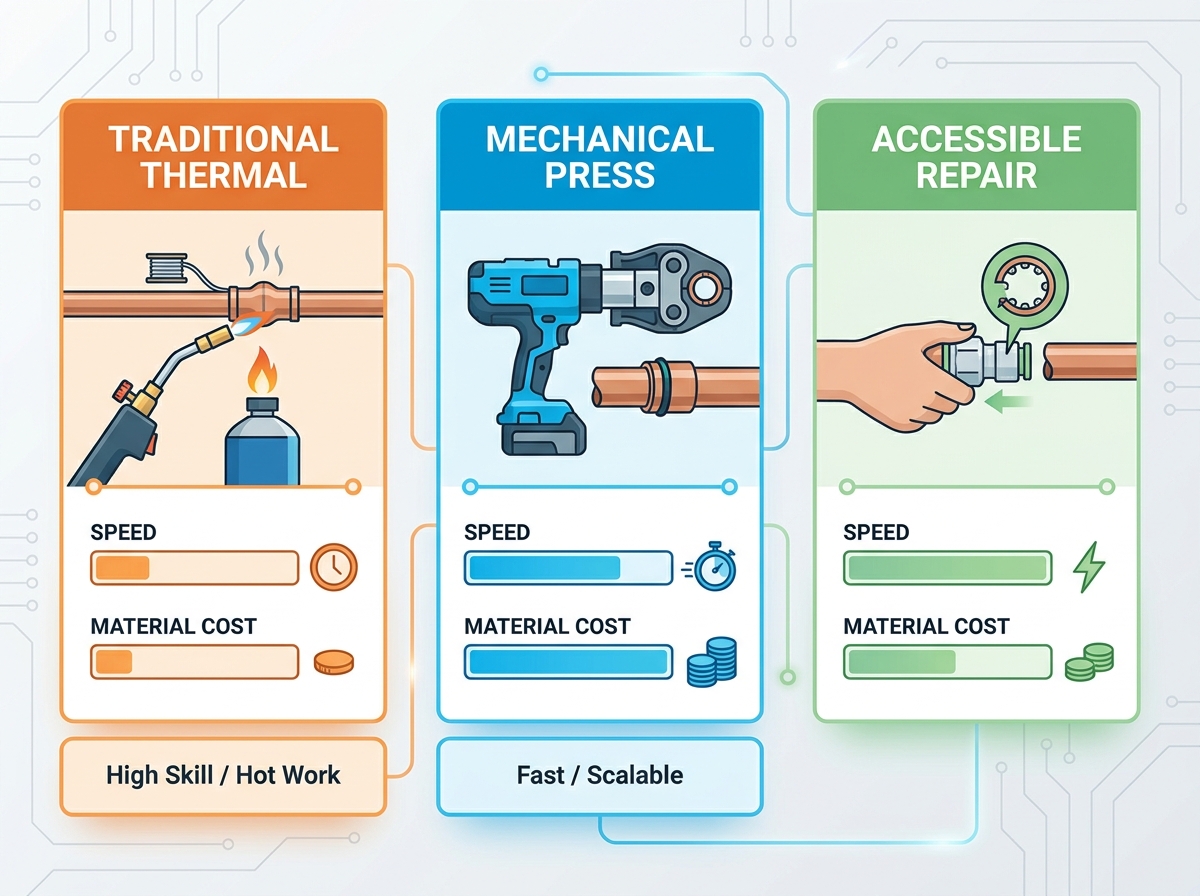
Mechanical press technology has completely transformed large-scale plumbing. Let us look closely at how press technology works. An installer utilizes a heavy, battery-powered electro-hydraulic tool. This tool compresses a manufactured fitting securely onto the pipe. The fitting contains a precision-engineered elastomeric O-ring. These rubber seals are typically made of EPDM, HNBR, or FKM. The heavy tool jaws crush the metal uniformly onto the seal.
The business impact and ROI are undeniably massive. It reduces connection time from several minutes to just seconds. You simply cut, deburr, mark the depth, and press. It entirely eliminates hot work permits and dedicated fire watches. You drop the need for prolonged system downtime. You can safely press these fittings onto wet pipes.
You must view this technology through specific evaluation lenses. O-ring compatibility is your most critical safety check. You absolutely must match the sealing element to the internal application. Use HNBR exclusively for volatile gas lines. EPDM is strictly designated for potable water. Using EPDM on a gas line causes rapid chemical degradation.
You also must acknowledge the tooling monopoly challenge. Scaling a project with modern mechanical joints requires significant capital. Commercial press tools are incredibly expensive upfront investments. Jaw compatibility risks exist between different tool manufacturers. You cannot always mix brands of jaws and fittings safely. You lock your business into a specific tooling ecosystem.
Push-to-connect fittings offer rapid convenience on the job site. The primary use case is executing fast emergency repairs. They are brilliant for transitioning between disparate pipe materials. You can bridge a copper line directly to PEX or CPVC seamlessly.
We must offer a very skeptical assessment regarding their concealed use. They are technically rated for concealed spaces in some plumbing codes. However, experienced contractors generally limit them to accessible access panels. These fittings rely on internal grab-rings and rubber O-ring seals. They lack the permanent structural integrity of a welded joint. Risk-averse plumbers avoid burying them permanently behind expensive bathroom tile.
Compression and flare joints serve highly specific mechanical purposes. A common use case includes fixture stops and delicate instrumentation. They are also heavily used for flexible copper tubing on gas lines. They utilize mechanical pressure rather than internal rubber seals.
These methods carry strict physical limitations. Compression joints are highly prone to failure if over-tightened by the installer. Excess torque crushes the internal brass ferrule and causes slow leaks. Flare joints require highly specialized flaring block tools. They demand precise, perfectly angled execution to avoid micro-leaks. A scratched flare face will never seal correctly under pressure.
Contractors need clear frameworks to make profitable purchasing decisions. Below is a structured matrix to streamline your selection process. Let us outline the right choice for various project scopes.
Table 1: Copper Pipe Joining Applications Matrix
| Method | Ideal Application | Key Advantage | Primary Limitation |
|---|---|---|---|
| Soldering | Residential Water | Lowest Material Cost | Requires Dry Pipes & Fire Risk |
| Brazing | HVAC/R & Med Gas | Extreme Pressure Rating | Requires Nitrogen Purge |
| Press Fittings | Commercial Builds | Speed & Safety | High Tooling & Fitting Cost |
| Push-to-Connect | Emergency Repairs | No Tools Needed | Questionable Concealed Longevity |
Here are specific recommendations based on industry best practices. Follow these closely to optimize your project execution.
You must define your next-step actions clearly. Audit your labor force's current technical certifications. Calculate the exact breakeven point on expensive press tool investments. Consult your local plumbing inspector directly. Ask them specifically regarding behind-the-wall mechanical joints before starting work.
No single connection method is universally superior in all scenarios. The best choice is always a complex equation. You must balance system demands, labor availability, and risk mitigation. What works beautifully for a residential bathroom fails in a commercial boiler room.
Our final recommendation focuses on holistic project planning. Base your procurement on the complete sum of materials, labor, and failure risk. Do not base decisions solely on the individual price tag of the fitting. A cheap fitting is worthless if it demands three hours of intensive labor.
Take immediate action on your upcoming jobs. Consult manufacturer spec sheets for O-ring chemical compatibility. Verify your local plumbing code amendments before placing bulk material orders. Proper upfront research prevents catastrophic failures down the line.
A: Yes, but transitioning requires careful and strategic planning. You must manage heat transfer carefully. For example, you should solder a transition fitting before pressing the other side. If you solder too close to a press fitting, the extreme heat will melt the internal EPDM O-ring and cause an immediate leak.
A: While certified by regulatory bodies like ASSE 1061, industry best practice advises caution. Risk-averse contractors advise keeping them strictly in accessible areas. Storing them behind access panels mitigates long-term liability. Rubber seals degrade over decades, making them riskier than permanent soldered connections inside closed walls.
A: This is highly code dependent. Some local jurisdictions and manufacturers allow it. They require the joint to be securely wrapped or protected against corrosive soil elements. However, brazing is often the safer, code-preferred method for buried copper. Brazed joints lack rubber seals that might degrade under heavy soil pressure.
A: Yes, the extreme heat anneals and softens the copper near the joint. This structural change is completely unavoidable. This is exactly why proper support spacing is mandatory. Adhering strictly to pressure-temperature ratings and adding adequate hanger supports are critical engineering steps to prevent sagging and stress fractures.


