
Views: 0 Author: Site Editor Publish Time: 2026-08-30 Origin: Site
A mismatched or low-quality pipe kit is the leading cause of refrigerant leaks, reduced cooling efficiency, and premature compressor failure. You might assume any copper tubing will successfully connect your indoor and outdoor units. However, the decision goes far beyond simply matching pipe length. It requires rigorously evaluating material grades, insulation standards, and system compatibility. Modern high-pressure refrigerants like R410A and R32 demand highly durable components to function safely. If you install thin-walled or poorly insulated lines, you risk micro-leaks and immediate energy loss. This guide provides a strict, evidence-based framework for evaluating, shortlisting, and purchasing the correct installation kit. Whether you are upgrading a residential unit or deploying commercial split systems, we will show you how to protect your equipment. You will learn exactly what specifications matter and how to avoid catastrophic installation errors.
Your connecting pipes serve as the circulatory system for your air conditioner. They carry vital refrigerant between the condenser and the evaporator. If you compromise on this component, you directly degrade overall performance. We evaluate this impact across three critical dimensions.
Every air conditioner earns a Seasonal Energy Efficiency Ratio (SEER) rating under ideal laboratory conditions. Precise pipe sizing protects this rating in the real world. Undersized lines create excessive friction. This restricts refrigerant flow and causes severe pressure drops. Consequently, the compressor must overwork to maintain the desired temperature. This extra strain spikes your energy consumption and neutralizes any high-efficiency benefits you paid for. Proper sizing keeps velocity optimal.
Refrigerant frequently changes states from liquid to gas. High-density insulation prevents unintended thermal loss during this transit. If the lines run through hot attics or sun-baked exterior walls, bare or poorly insulated copper absorbs ambient heat. This forces the system to work harder to cool the air. Furthermore, poor insulation leads to rapid condensation buildup. Water drips can damage building materials and encourage mold growth inside wall cavities.
You must use ACR-grade (Air Conditioning and Refrigeration) copper. Plumbing-grade copper carries moisture and lacks the structural integrity for HVAC applications. Water-grade tubing oxidizes quickly when exposed to refrigerants. This oxidation creates internal flaking. These debris particles travel through the lines and clog the expansion valve. A blocked valve starves the compressor of oil, leading to total mechanical failure. Proper ACR copper prevents this contamination.
You cannot judge a pipe kit by its packaging. You must examine the precise technical details. Evaluating air conditioner connecting pipe kit specifications ensures your system operates safely under high pressure. Focus on sizing, copper grade, and insulation standards.
Pipe diameter must precisely match your unit's BTU rating. Every system requires a specific liquid line and gas line pairing. If you size up without manufacturer approval, the refrigerant velocity drops. Low velocity prevents proper oil return to the compressor. If you size down, you choke the flow and cause freezing. Always verify dimensions.
Table: Standard AC Capacity to Pipe Dimension Pairings
| Cooling Capacity (BTU) | Liquid Line Size (Inches) | Gas Line Size (Inches) | Common Application |
|---|---|---|---|
| 9,000 – 12,000 BTU | 1/4" | 3/8" | Small Bedrooms, Offices |
| 18,000 BTU | 1/4" | 1/2" | Living Rooms, Large Spaces |
| 24,000 – 30,000 BTU | 3/8" | 5/8" | Light Commercial, Basements |
| 36,000+ BTU | 3/8" | 3/4" | Whole-House Split Systems |
The copper tubing market offers Type K, Type L, and Type M grades. Type M features the thinnest walls. You should never use Type M for high-pressure HVAC systems. Type L represents the standard for most residential cooling applications. Type K provides the thickest walls and suits heavy-duty commercial jobs. Modern refrigerants like R410A and R32 operate at exceptionally high pressures. You need a minimum wall thickness between 0.7mm and 0.8mm. Thinner walls suffer from structural fatigue and develop micro-leaks over time.
Insulation matters just as much as the copper itself. You should insist on closed-cell elastomeric foam. This material blocks moisture vapor transmission. Open-cell foam absorbs water and loses its insulating properties. Additionally, outdoor segments require strict UV resistance. The sun rapidly degrades standard foam, turning it brittle. You also need verified fire retardant ratings to meet local building codes. Properly rated insulation maintains its flexibility and thermal resistance for decades.
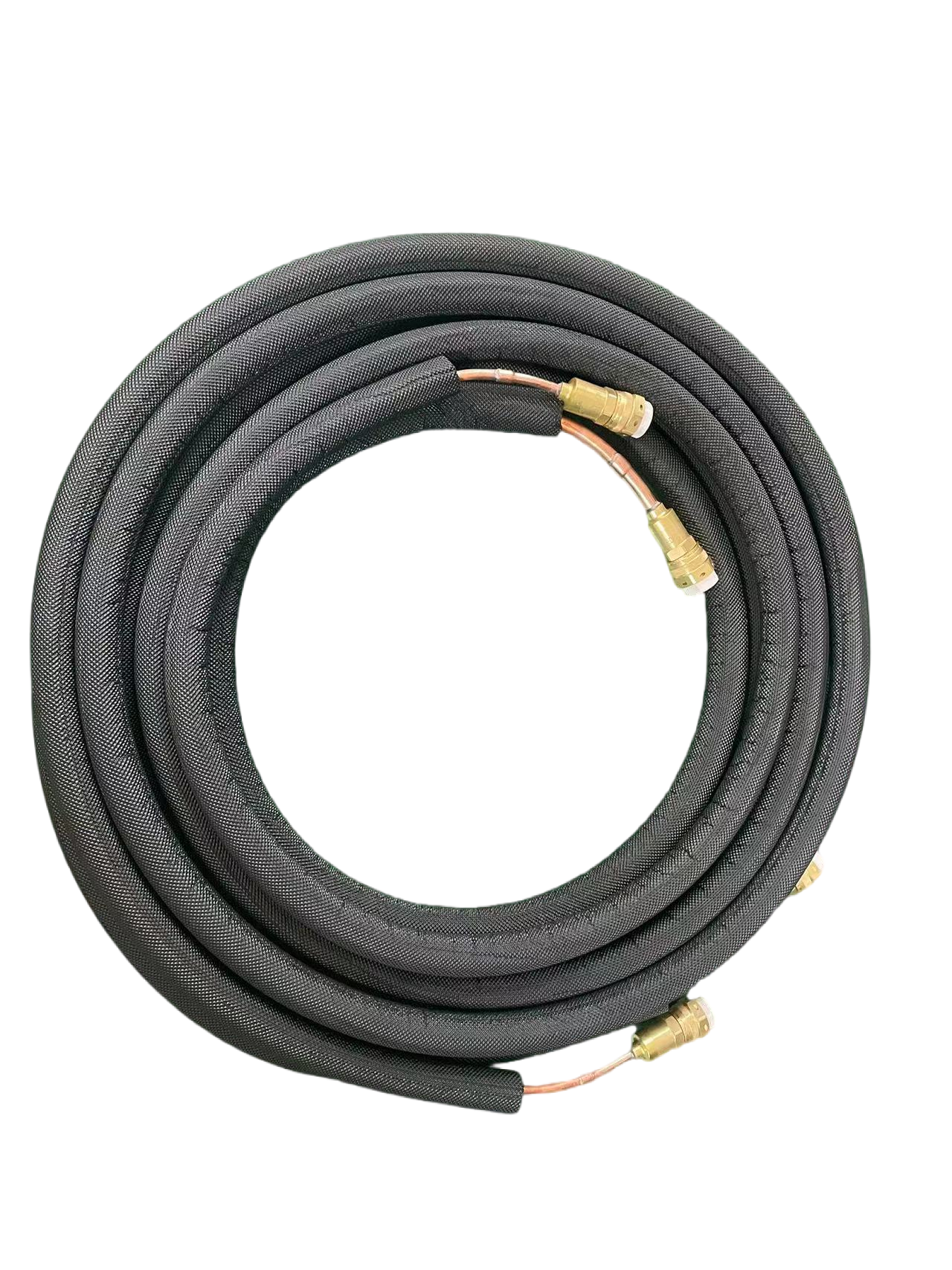
You face two primary choices when selecting your installation method. Traditional flared kits offer flexibility, while modern alternatives prioritize speed. Understanding the differences helps you deploy the right solution for your specific project.
Professionals have used traditional flared kits for decades. They arrive unsealed and uncharged. You must cut them to length, flare the ends, and vacuum the lines manually.
A vacummed quick connecting pipe for air system revolutionizes residential installations. These kits leave the factory completely sealed and evacuated of air. Some even come pre-charged.
We created a simple matrix to guide your selection process.
Chart: Approach Comparison Matrix
| Project Scenario | Recommended Approach | Primary Justification |
|---|---|---|
| Commercial / Custom Builds | Standard Flared Kits | Requires exact custom routing and length adjustments on-site. |
| Rapid Deployment / DIY | Pre-Vacuumed Quick Connects | Eliminates the need for expensive vacuum pumps and specialized training. |
| Ultra-Long Runs (Over 50 ft) | Standard Flared Kits | Avoids massive coils of excess pre-cut tubing. Brazing may be required. |
| Temporary / Modular Structures | Pre-Vacuumed Quick Connects | Fast setup and teardown capabilities with zero specialized equipment. |
Purchasing the right air conditioner connecting pipe kit solves only half the equation. You must install it flawlessly. Field conditions introduce mechanical risks. Pay close attention to bending, contamination, and routing.
You must route copper lines around corners, through walls, and over obstacles. This requires bending. However, sharp bends cause kinking. A kinked line restricts flow and damages the compressor. You must specify annealed (soft) copper. Annealed copper bends safely without micro-fracturing. Always use a proper mechanical tube bender for tight corners. Never bend the pipe sharply by hand. Keep the bending radius wide to ensure smooth fluid dynamics.
Internal copper surfaces must remain surgically clean. The slightest presence of moisture reacts with refrigerant oil to form corrosive acids. These acids destroy the compressor windings. To prevent this, strict contaminant control is necessary.
Physical routing impacts system physics. You must factor in maximum vertical lift. If the outdoor condenser sits significantly higher than the indoor unit, gravity fights the refrigerant flow. Oil can pool at the bottom of the run. To counteract this, installers must build inverted oil traps into the vertical lines. Furthermore, longer pipes are not always better. Extended runs cause pressure drops. They also require you to weigh in an additional refrigerant charge beyond the factory baseline. Cross-reference the manual for absolute length limits.
You rely on your vendor to provide safe, durable materials. A cheap kit often hides recycled alloys and porous insulation. You must thoroughly vet your air conditioner connecting pipe kit supplier before placing an order.
Do not accept vague marketing claims. Insist on hard documentation. A reputable vendor will provide certificates proving 99.9% copper purity (CU). They should demonstrate compliance with international ACR standards, such as ASTM B280. If they cannot produce these spec sheets upon request, move to another vendor immediately. Purity prevents early degradation.
Evaluate what actually comes in the box. Bare pipes do not make a complete kit. Premium suppliers include heavy-duty brass flare nuts. Cheap kits often substitute thin metal nuts that crack under torque. Look for UV-resistant wrapping tape, durable wall sleeves, and non-hardening sealing putty. Having these accessories included saves you time and ensures a professional finish.
Copper is soft. It damages easily during transit. Assess the supplier's packaging protocols. Do they use reinforced cardboard? Do they cushion the coils to prevent crimping? A dented pipe acts as a flow restrictor. If the insulation arrives torn, it will immediately attract condensation. Strong logistics prevent expensive job-site delays.
Mistakes happen. Factories occasionally produce defective flares or compromised vacuum seals. You need a vendor with a transparent, no-nonsense return policy. Evaluate their technical support responsiveness. Can you call an engineer if you encounter a proprietary valve mismatch? Strong warranties signal that the manufacturer trusts their own manufacturing tolerances.
The right air conditioner connecting pipe kit is never a mere commodity. It serves as a critical system component that dictates the lifespan and daily efficiency of your AC unit. Treating it as an afterthought invites leaks, compressor strain, and costly emergency repairs. You must prioritize proper dimensions, adequate wall thickness, and high-quality elastomeric insulation.
Before you begin your next installation, take these action steps. First, cross-reference your AC unit's installation manual to determine exact diameter pairings and maximum length limits. Next, map out your physical routing path to avoid extreme bends and calculate vertical elevation risks. Finally, request verifiable technical spec sheets from potential suppliers rather than just comparing basic price lists. Quality materials protect your investment.
A: We strongly advise against reusing old pipes. Older systems often used different refrigerants, like R22. The mineral oil from R22 incompatible with modern POE oils used in R410A systems. Cross-contamination destroys compressors. Additionally, older pipes usually lack the wall thickness required to handle modern, high-pressure refrigerants safely.
A: Exceeding maximum length limits causes severe pressure drops. It forces the compressor to work harder, dramatically lowering your cooling capacity. Long runs also risk oil starvation, as the compressor oil struggles to circulate back. You will also need to add supplementary refrigerant to account for the extra volume.
A: Do not rely solely on product descriptions. You should check the printed specifications directly on the insulation jacket or the copper tubing itself. Reputable brands stamp their dimensions and ASTM compliance codes along the pipe length. Always request official manufacturer compliance certificates from your supplier.


