
Views: 0 Author: Site Editor Publish Time: 2026-02-13 Origin: Site
If you know the system type, you’re already halfway to the right solution. In real HVAC-R projects, many selection mistakes happen not because the fitting is poorly made, but because it is used in the wrong application. ACR fittings are designed for specific refrigeration and air-conditioning scenarios, and understanding where they are used most helps buyers, engineers, and maintenance teams quickly identify what they actually need. Ningbo Top Hcool Metal Fittings supplies both standard ACR copper fittings and VRF branch and refnet solutions, supporting a wide range of refrigeration systems with stable quality and customizable options. This article focuses entirely on usage scenarios, showing where ACR fittings are most commonly applied and why matching the application correctly matters for performance, reliability, and long-term cost.
Split air conditioners and heat pumps represent the largest volume of HVAC installations worldwide. These systems rely on relatively simple piping layouts, usually consisting of liquid lines, gas lines, elbows, reducers, and straight connectors. Because of the high installation volume, small inconsistencies are multiplied across thousands of systems.
In these everyday systems, leakage most often appears at joints rather than along straight pipe runs. The reason is straightforward: joints experience the combined effects of brazing quality, vibration, and thermal cycling. When ACR fittings are used with correct outside diameter matching and proper workmanship, joints remain stable even after years of operation. When unsuitable fittings are substituted, micro-leaks may develop slowly and only become visible after cooling performance drops.
Many buyers underestimate the importance of OD matching and installation discipline in split AC and heat pump systems. Because the systems are smaller and familiar, there is a tendency to treat fittings as interchangeable. In reality, refrigeration copper tubing and fittings must align precisely by outside diameter to ensure even brazing and predictable joint strength.
ACR fittings are sized and manufactured specifically for refrigeration tubing, making them well suited for these high-volume applications. For manufacturers and installers, this reduces rework, shortens installation time, and lowers the risk of callbacks.
Commercial refrigeration systems and cold rooms operate under constant demand. Supermarkets, food processing plants, and logistics centers depend on uninterrupted cooling to protect products and meet regulatory requirements. In these environments, downtime is expensive, and maintenance teams favor standardized components that can be identified and replaced quickly.
ACR fittings play a critical role in these systems because they offer consistent sizing and predictable performance. When maintenance staff can recognize fittings easily and know they will match existing tubing, repairs can be completed faster and with greater confidence.
In cold room applications, certain fitting sizes tend to fail more often due to vibration near compressors or frequent defrost cycles. Stocking high-turn ACR fitting sizes allows maintenance teams to respond immediately rather than improvising with unsuitable alternatives.
Ningbo Top Hcool Metal Fittings supplies standard ACR copper fittings produced through red punched forging or direct copper pipe forming, mainly using TP2 and T2 materials. This consistency supports spare parts planning and helps operators maintain stable refrigeration performance over long service periods.
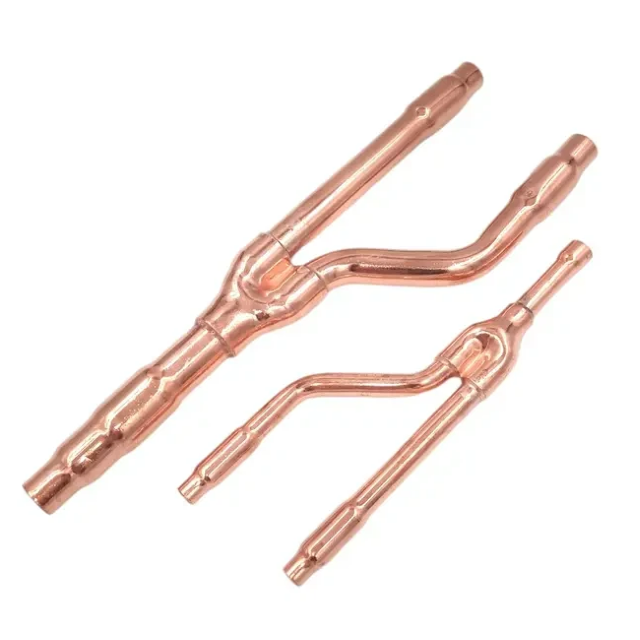
VRF and VRV systems introduce a completely different level of complexity. Instead of a single indoor unit, these systems connect one outdoor unit to multiple evaporators through branching networks. Branch pipes, also known as copper refnet joints or Y branch pipes, are the core components that make this distribution possible.
In a typical VRV air-conditioning system, refrigerant passes through an expansion valve or capillary device and enters the branch through the liquid line. From there, it is divided into multiple branches that supply individual indoor units. After absorbing heat in the evaporators, the refrigerant returns as gas through the gas pipe to the compressor. The gas pipe is generally thicker than the liquid pipe, reflecting different flow and pressure requirements.
Because branch pipes control how refrigerant is divided and returned, their design directly affects system balance and efficiency.
Unlike simple elbows or tees, branch pipes in VRF systems must be installed in the correct orientation and position. Improper layout can lead to uneven refrigerant distribution, poor oil return, or unstable system operation. Even a small deviation in branch design can result in some indoor units underperforming while others receive excess refrigerant.
ACR copper refnet joints supplied by Ningbo Top Hcool Metal Fittings are produced mainly from TP2 copper and are available in different diameters to match various air-conditioner brands. Using fittings designed specifically for VRF layouts helps ensure that the system operates as intended and remains easier to maintain over time.
Beyond traditional HVAC systems, ACR fittings are also used in valves, communication equipment, and specialized refrigeration machinery. These applications often involve compact layouts, unusual connection angles, or specific pressure requirements that standard fittings cannot always meet.
In such cases, customized copper fittings become necessary. Rather than forcing a standard part into an unsuitable role, custom fittings allow designers to maintain system integrity while meeting space and performance constraints.
Material choice and forming process are especially important in special equipment applications. TP2 and T2 copper are commonly selected because of their stable mechanical properties and consistent purity. Ningbo Top Hcool Metal Fittings combines these materials with advanced CNC machines and skilled workmanship to produce fittings that perform reliably across different industries.
Whether the application involves refrigeration, valves, communications, or plumbing, using the correct material and process ensures that fittings behave predictably under real operating conditions.
Before selecting any fitting, it is useful to map the application scenario clearly. The system type, tube diameter, connection method, and need for branching all influence the correct choice. The table below provides a simplified overview to help users quickly identify where different ACR fittings are typically used.
Application | Typical ACR Fittings | Key Selection Note |
Split AC | Straight connectors, elbows, reducers | Focus on OD matching and brazing quality |
Heat pump | Copper couplings, return bends | Consider thermal cycling resistance |
Cold room | Standard ACR fittings | Stock high-turn sizes for maintenance |
VRF heat recovery | Copper refnet joints | Correct orientation is critical |
Multi-zone VRF | Branch pipes and reducers | Match diameter to specific brand |
This type of mapping allows buyers to narrow their options quickly and avoid using fittings outside their intended application.
Standard ACR fittings are suitable for most split AC systems, heat pumps, and commercial refrigeration lines where piping layouts are straightforward. These fittings offer reliable performance, easy installation, and predictable maintenance behavior.
Ningbo Top Hcool Metal Fittings provides a full range of standard ACR copper fittings to support these applications.
When the system involves multiple indoor units and refrigerant branching, specialized components are essential. VRF and VRV systems require copper refnet joints or branch pipes designed to manage refrigerant flow and oil return correctly.
For these applications, Ningbo Top Hcool Metal Fittings offers ACR copper refnet joints produced from TP2 copper in multiple diameters to match different system brands.
By aligning the product category with the actual application scenario, users reduce the risk of performance issues and simplify future maintenance.
Selecting fittings based on usage scenario rather than habit makes a measurable difference in system performance and reliability. Split AC systems, cold rooms, VRF networks, and special equipment all place different demands on piping components, and matching those demands correctly helps prevent leaks, imbalance, and unnecessary downtime. Ningbo Top Hcool Metal Fittings supports this application-driven approach by supplying standard ACR fittings as well as customized TP2 and T2 copper solutions, including branch pipes for complex VRF systems. When the usage scenario drives the selection, the result is a more stable system and greater confidence in long-term operation using the right refrigeration copper fittings. Contact us today to share your system type, tube diameters, and connection method, and let us support your project with the appropriate ACR solutions.
Where are ACR fittings most commonly used?
They are widely used in split AC systems, heat pumps, commercial refrigeration, cold rooms, and VRF or VRV systems.
Why are branch pipes necessary in VRF systems?
Branch pipes distribute refrigerant evenly to multiple indoor units and support proper oil return to the compressor.
Can standard ACR fittings be used in special equipment?
In some cases yes, but compact or non-standard layouts often require customized copper fittings.
How does application mapping help reduce selection mistakes?
By matching system type and layout to the correct fitting category, users avoid using components outside their intended purpose.


