
Views: 0 Author: Site Editor Publish Time: 2026-02-19 Origin: Site
Choosing the right components for a refrigeration system does not have to be complicated. In practice, technicians follow a clear order when making decisions on site, and buyers who understand this order avoid most sizing errors and rework. ACR fittings are not generic copper parts; they are system-critical components that must match tube dimensions, layout complexity, and operating conditions. Ningbo Top Hcool Metal Fittings supports both standard ACR system fittings and refnet or branch pipe options, helping customers turn technical requirements into clear purchasing decisions. This article provides a step-by-step selection framework that mirrors real field logic, making it easier to prepare accurate inquiries and achieve reliable installation results.
The most common starting point in selecting ACR fittings is the outside diameter of the copper tube. In refrigeration and air-conditioning systems, tubes are specified and identified by their actual outside diameter rather than by nominal size. This convention ensures that fittings and tubes align precisely during installation.
When OD matching is correct, brazing gaps are consistent, heat distribution is predictable, and joint strength is easier to control. ACR fittings are manufactured specifically to match refrigeration tubing standards, which reduces ambiguity and supports repeatable installation quality across projects.
Mis-orders often happen when buyers rely on nominal size references from plumbing systems or assume that two copper tubes of similar appearance share the same dimensions. In mixed environments where refrigeration and water piping coexist, this confusion becomes even more likely.
To avoid this mistake, always confirm the tube OD directly from technical drawings or physical measurement before placing an order. Treat OD as the non-negotiable starting point of the selection process. Once the OD is confirmed, all other decisions become clearer.
System type determines how demanding the fitting requirements will be. Simple line sets, such as those used in split air conditioners or basic heat pumps, usually involve straightforward liquid and gas lines with limited branching. In these cases, standard ACR fittings are often sufficient as long as OD and connection method are correct.
Multi-branch networks, on the other hand, introduce additional complexity. Systems that connect one outdoor unit to multiple indoor units require careful control of refrigerant distribution and oil return. In such layouts, the role of each fitting becomes more critical.
VRF and VRV systems depend on branch pipes to divide refrigerant flow correctly. These systems are designed around precise piping rules, and branch components are engineered to match specific system requirements. For example, some well-known VRF systems specify exact branch configurations to ensure balanced performance across all indoor units.
In these applications, using standard fittings where branch solutions are required can disrupt refrigerant balance and lead to uneven cooling. Selection must follow system requirements rather than convenience. Understanding whether the system uses simple lines or complex branching is essential before choosing any fitting.
Brazing remains the most common connection method in refrigeration systems. When selecting ACR fittings for brazed joints, several practical details matter. OD matching ensures uniform brazing gaps, while wall thickness affects heat absorption and joint strength. Access to the joint location also influences how easily proper brazing can be achieved.
Providing this information during selection helps ensure that the fitting performs as expected under real installation conditions. ACR fittings designed for brazing support consistent filler flow and long-term joint stability.
In some projects, press connections may be used to improve installation speed. However, press fittings introduce additional considerations, such as heat sensitivity near seals and workflow compatibility with existing tools. Mixing press and brazed connections within the same system requires careful planning.
The key is to select fittings that match the connection method actually used on site, not the method assumed during design. Misalignment between design intent and installation practice increases the risk of leaks and callbacks.
Material choice directly affects performance and reliability. TP2 and T2 copper are widely used in refrigeration applications because of their stable mechanical properties and consistent purity. These materials support predictable brazing behavior and reliable long-term operation under pressure and thermal cycling.
Ningbo Top Hcool Metal Fittings manufactures ACR fittings primarily from TP2 and T2 copper, using red punched forging processes or direct copper pipe forming. This approach ensures consistent dimensions and material behavior across batches.
Standard fittings cover many applications, but not all. Compact equipment layouts, unusual connection angles, or special system requirements may make standard parts unsuitable. In these cases, customization provides a better solution than forcing a standard fitting into an inappropriate role.
Custom copper fittings allow designers to maintain system integrity without compromising performance. Choosing customization at the right time reduces installation difficulty and simplifies long-term maintenance.
A clear request for quotation saves time for both buyers and suppliers. At minimum, an RFQ for ACR fittings should include a complete OD size list, drawings or photos if available, the application type, required quantities, and the intended connection method. This information allows suppliers to confirm feasibility and pricing quickly.
Incomplete RFQs often lead to back-and-forth communication, delays, and higher risk of misunderstanding. Providing accurate details upfront improves efficiency and confidence on both sides.
Beyond basic dimensions, buyers should specify labeling expectations, packaging requirements, and inspection standards. Clear identification helps prevent mixing sizes on site, while clean packaging supports refrigeration system requirements. Discussing these details early helps align expectations and reduces the chance of errors during delivery and installation.
For split AC systems, heat pumps, and many commercial refrigeration lines, standard ACR fittings are the most efficient choice. These fittings offer reliable performance, consistent sizing, and straightforward installation.
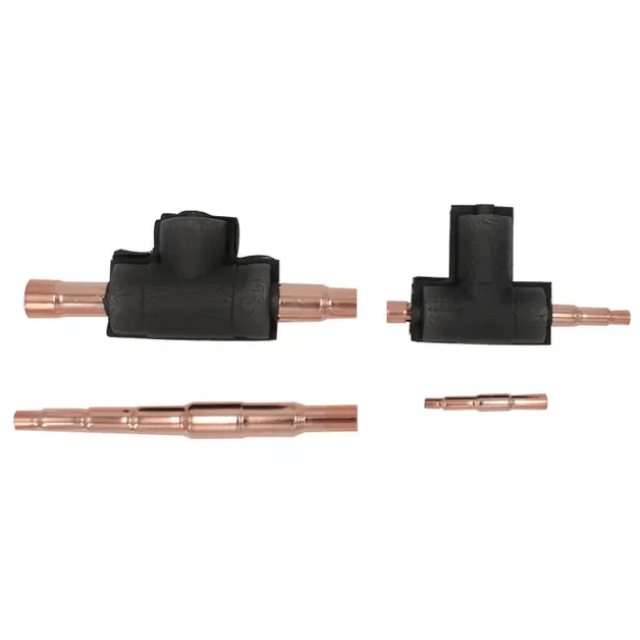
When the system involves multiple indoor units and refrigerant branching, specialized components are required. Branch pipes, also known as copper refnet joints or Y branch pipes, are used to connect the outdoor unit to multiple evaporators in VRV systems.
These components are divided into liquid and gas pipes, with the gas pipe generally thicker than the liquid pipe. Refrigerant is throttled and distributed through the liquid branch, then returns as gas after absorbing heat in the evaporator. Ningbo Top Hcool Metal Fittings manufactures ACR copper refnet joints mainly from TP2 copper, offering different diameters to match various air-conditioner brands.
Your System | Tube OD | Connection Method | Need Branching | What to Buy | What to Provide for Quote |
Split AC | Confirm actual OD | Brazed | No | Standard ACR fittings | OD list and quantity |
Heat pump | Confirm actual OD | Brazed | No | Standard ACR fittings | OD and wall thickness |
Cold room | Confirm actual OD | Brazed | No | Standard ACR fittings | Application and spares |
VRF heat recovery | Brand-specific OD | Brazed | Yes | Copper refnet joints | System layout and brand |
Multi-zone VRF | Mixed ODs | Brazed | Yes | Branch pipes and reducers | Drawings and OD details |
This matrix turns selection logic into a practical checklist that buyers can use before contacting suppliers.
Selecting the right components is easier when decisions follow a clear and logical order. Start with tube OD, confirm system type and layout, choose the connection method you will actually use, verify material consistency, and prepare a complete RFQ. This approach reduces errors, shortens lead times, and improves installation results. Ningbo Top Hcool Metal Fittings supports customers through this process by supplying standard ACR fittings and customized TP2 and T2 copper solutions, including branch pipes for complex VRF systems. When selection is driven by system requirements rather than assumptions, the result is smoother installation and greater confidence in long-term performance using dependable ACR fittings selection practices. Contact us today with your OD sizes, system type, and connection method, and let us help you match the right fittings to your refrigeration system.
What is the first step in choosing ACR fittings?
Always start by confirming the actual outside diameter of the copper tube, not the nominal size.
Do all refrigeration systems need branch pipes?
No. Branch pipes are mainly required in VRF and VRV systems with multiple indoor units.
Why are TP2 and T2 copper materials preferred?
They provide stable mechanical properties and consistent purity, supporting reliable brazed joints.
What information should be included in an RFQ for ACR fittings?
An RFQ should include OD sizes, application type, connection method, quantities, and drawings or photos if available.


