
Views: 0 Author: Site Editor Publish Time: 2026-02-06 Origin: Site
Most refrigerant leaks are not dramatic failures that stop a system overnight. They begin quietly, often at a joint that looked fine during installation, and only become visible when cooling performance drops and refrigerant needs to be refilled. In daily service work, ACR fittings are frequently the hidden factor behind these costly callbacks. At Ningbo Top Hcool Metal Fittings, we manufacture and supply ACR copper fittings and VRF branch solutions, and we see a clear pattern: systems that follow a structured maintenance routine and use consistent, correct-spec fittings experience far fewer leaks and unplanned shutdowns. This article focuses entirely on maintenance—how leaks really start, what to check at different intervals, and when replacement is the smarter decision—so customers can protect system reliability while sourcing stable, repeatable ACR components.
In most refrigeration systems, the first failure point is not the copper tube itself but the joint. Brazed connections experience repeated expansion and contraction as systems start and stop. Over time, vibration from compressors and fans adds mechanical stress. If brazing quality was inconsistent or filler metal distribution was uneven, microscopic cracks can form. These cracks may not release refrigerant immediately, but they gradually grow until pressure loss becomes noticeable.
High-quality ACR fittings are designed with joint geometry that supports even brazing and predictable filler flow. When fittings and tubes match precisely by outside diameter, heat distribution during installation is easier to control, which directly improves joint longevity during maintenance cycles.
Another common leak pattern appears outside the fitting. Condensation forming on copper lines is not just a comfort issue; it is often the first visible sign of insulation failure. Once moisture repeatedly contacts copper surfaces, corrosion risk increases, especially at joints where geometry changes trap water.
Routine maintenance should treat damaged insulation as an urgent signal rather than a cosmetic problem. Protecting ACR fittings from prolonged moisture exposure is one of the simplest ways to prevent leaks from developing over time.
Some leaks are not mechanical at all. Moisture and contaminants introduced during installation or early operation can react with refrigerant and oil, creating acids that attack internal copper surfaces. These chemical processes take time, which is why failures linked to contamination often appear months or years after commissioning.
Clean handling of ACR fittings and proper dehydration procedures during installation reduce this risk significantly. Maintenance teams should remain alert to signs of internal contamination, especially when systems show unexplained performance decline.
Monthly inspections do not need to be time-consuming, but they should be consistent. A quick visual check of exposed ACR fittings can reveal oil stains, discoloration, or insulation damage. Listening for unusual noise or vibration near joints can also highlight developing issues.
These short inspections are especially valuable in commercial and VRF systems where small leaks can spread refrigerant loss across multiple indoor units before alarms are triggered.
Quarterly maintenance allows for a deeper look at known stress areas. Technicians should inspect brazed joints near compressors, expansion devices, and branch connections. Supports and clamps deserve attention as well, since loose supports increase vibration load on fittings.
Leak detection tools should be used at consistent checkpoints rather than randomly. Building a repeatable inspection route improves accuracy and makes trends easier to spot over time.
Annual maintenance, often scheduled during planned shutdowns, is the ideal time to assess long-term risks. This is when rework decisions should be made. If certain ACR fittings show repeated signs of stress or minor leakage, replacement is usually more economical than repeated repair.
This is also the right moment to review spare parts strategy. Identifying which fitting sizes fail most often allows maintenance teams to stock the right components and reduce response time during the next service cycle.
Checkpoint | What to Look For | Simple Action | Frequency | Risk if Ignored |
Brazed joints | Discoloration, oil traces | Inspect and document | Monthly | Hidden micro-leaks |
Insulation condition | Wet or damaged insulation | Repair or replace | Monthly | Corrosion at joints |
Supports and clamps | Looseness or wear | Tighten or replace | Quarterly | Increased vibration stress |
Branch connections | Uneven temperature | Recheck balance | Quarterly | Poor refrigerant distribution |
High-risk fittings | Repeated minor leaks | Plan replacement | Annually | Sudden system failure |
Reworking a joint without shielding nearby valves, seals, or insulation can introduce new problems. Excessive heat may damage components that were previously functioning well. Proper preparation before reheating a joint is essential to avoid turning a small repair into a larger failure.
Some systems combine brazed joints with flared or press connections. Applying the same maintenance approach to all connection types is a mistake. Each method has specific requirements for torque, heat, and inspection. Mixing practices increases the risk of improper sealing and premature leaks.
VRF and VRV systems follow strict piping layouts to ensure balanced refrigerant distribution. Ignoring these rules during maintenance, especially when replacing branch pipes or fittings, can disrupt oil return and system stability. Maintenance work must respect original system design to avoid long-term performance issues.
If a fitting shows repeated leakage at the same joint, fatigue is likely already present. Re-brazing may provide temporary relief, but the underlying material has often been compromised. Visible deformation or thinning at the joint is a clear signal that replacement is the safer option.
Upgrading refrigerants or increasing system capacity changes pressure and temperature profiles. ACR fittings that performed adequately under previous conditions may no longer meet the new demands. Proactive replacement during upgrades prevents future failures and aligns the system with its new operating range.
Maintenance-driven purchasing focuses on predictability. By identifying the ACR fitting sizes most likely to fail, teams can keep these components in stock. This strategy reduces downtime and allows for immediate replacement rather than temporary repairs that increase callback risk.
Ningbo Top Hcool Metal Fittings supplies a complete range of standard ACR copper fittings produced through red punched forgings or direct copper pipe forming. Consistent dimensions and material quality make these fittings suitable for fast replacement during maintenance without unexpected fit issues.
Our copper fittings are widely used in refrigeration, plumbing, valves, and communication equipment, allowing customers to maintain consistent sourcing across different applications.
Not all systems follow standard layouts. VRF installations, special equipment, or compact designs often require customized solutions. We manufacture custom copper fittings from TP2 and T2 materials to match specific diameters, branch configurations, or equipment interfaces.
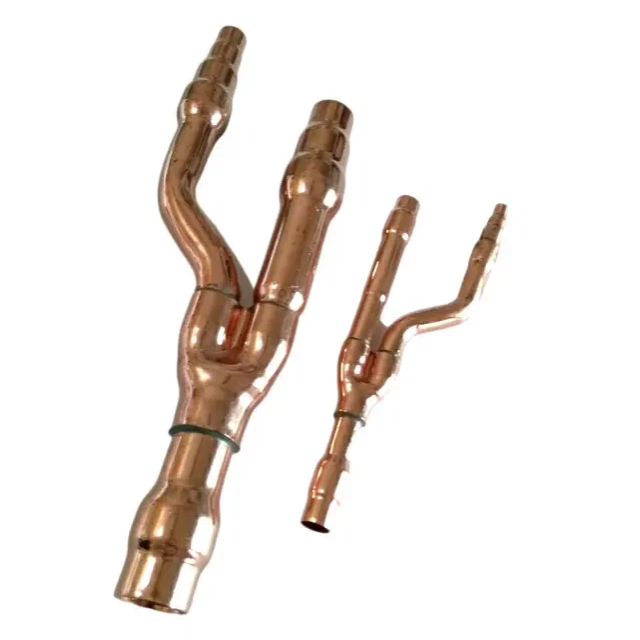
Our ACR copper refnet joints, also known as branch pipes or Y branch pipes, are designed for VRV air-conditioning systems. These components separate liquid and gas lines and distribute refrigerant evenly to multiple evaporators. Made mainly from TP2 copper, they are produced in different diameters to match various air-conditioner brands, supporting stable operation and easier maintenance.
Effective maintenance is not about reacting to leaks after they occur. It is about early detection, disciplined inspection routines, and timely replacement using the correct components. When systems rely on consistent materials, precise sizing, and predictable joint performance, callbacks decrease and operating costs remain under control. Ningbo Top Hcool Metal Fittings supports this approach by supplying reliable ACR copper fittings and customized TP2 and T2 solutions for both standard refrigeration lines and complex VRF branch systems. If your goal is to reduce leaks and service interruptions, investing in proper HVAC refrigerant leak prevention practices and quality components is the most practical path forward. Contact us to discuss your maintenance needs, explore our ACR fittings and copper refnet joint options, and keep your refrigeration systems running with confidence.
Why do leaks often appear long after installation?
Many leaks result from vibration, thermal cycling, or internal contamination that gradually weakens joints over time rather than immediate installation errors.
How often should ACR fittings be inspected?
A simple visual check should be done monthly, with more detailed inspections quarterly and a comprehensive review during annual shutdowns.
Is it better to repair or replace leaking ACR fittings?
Repeated leaks or visible fatigue usually indicate replacement is more reliable and cost-effective than repeated rework.
Do VRF systems require special maintenance for branch pipes?
Yes. Branch pipes play a key role in refrigerant distribution, and incorrect maintenance or replacement can affect oil return and overall system balance.


