
Views: 0 Author: Site Editor Publish Time: 2026-11-29 Origin: Site
In commercial HVAC and VRF/VRV networks, your choice of branching joints directly impacts refrigerant distribution. These specialized components also dictate compressor lifespan and overall energy efficiency. Multi-zone systems have rapidly become the industry standard across modern building designs. Because of this, engineering teams are shifting away from traditional T-branches. They now favor highly engineered branch piping solutions. Failing to adapt your piping strategy often leads to catastrophic system failures. Poor distribution starves distant indoor units and creates localized freezing issues.
We created this comprehensive guide to provide an objective evaluation of these crucial fittings. You will discover exactly how a Copper Refnet Joint measures up against standard traditional joints. Mechanical engineers, installation contractors, and procurement teams can leverage these practical insights. They will help you specify the correct components to meet your immediate project requirements.
Multi-zone HVAC systems fail when refrigerant favors the path of least resistance. This equalization challenge starves distant indoor units of necessary cooling capacity. If you use standard pipe fittings, the fluid naturally flows toward the closest drops. The furthest units receive inadequate liquid refrigerant. They struggle to maintain the designated room temperature. This creates major comfort issues for building occupants. It also disrupts the entire thermal balance of the building.
Improper branching causes severe pressure drops across the piping network. It alters the saturation temperature of the refrigerant. It also creates uneven liquid and gas ratios within the system. These extreme imbalances force the compressor to overwork constantly. It struggles to push enough refrigerant to those distant zones. Over time, this constant strain degrades internal compressor components. We often see premature motor burnout in these compromised systems. Poor joints also trap essential compressor oil in the lines. If the oil cannot return to the compressor, mechanical friction destroys the bearings.
A successful piping joint strategy requires several strict criteria. You need minimal pressure drop across the entire network. You must achieve accurate two-phase fluid separation at every branch. Your design must ensure full warranty compliance from the equipment manufacturer. Finally, you need predictable installation times for your contracting teams. Meeting these goals ensures long-term reliability. We always advise clients to prioritize engineered solutions to avoid systemic failures.
Standard T-joints and standard Y-fittings serve basic plumbing needs well. Manufacturers originally designed them for legacy single-split AC units. Plumbers use them to split single-phase fluids like water. They work well when equal distribution is not critical. These basic fittings rely on a simple perpendicular split. The design completely ignores complex fluid dynamics. It assumes the fluid will simply find its way to the destination.
Traditional T-joints create massive flow turbulence inside the piping. They fail to separate gas and liquid refrigerants evenly. When two-phase refrigerant hits a standard T-joint, the heavier liquid crashes into the flat wall. The lighter gas escapes easily through the branch. This dynamic destroys the delicate phase ratio. Modern electronic expansion valves require a specific mixture to function properly. Depriving them of this mixture causes immediate efficiency losses. It also creates noisy operation at the indoor unit.
Despite these limitations, traditional joints still have a place in specific scenarios. We recommend them for limited applications where advanced engineering is unnecessary. You can save money by utilizing them where appropriate.
Ideal Scenarios:
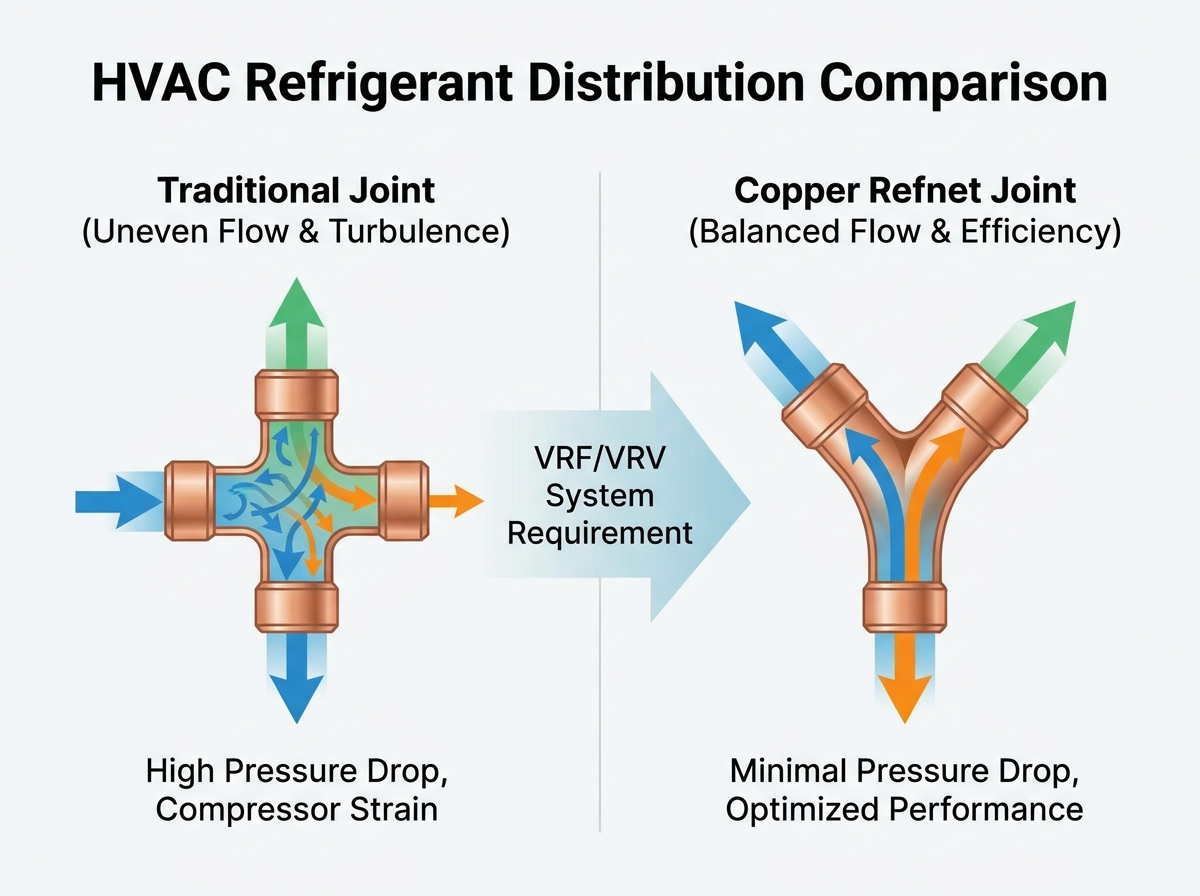
A Copper Refnet Joint uses a highly specialized engineering design. It features a unique Y-branch or header shape. This specific geometry splits the flow of two-phase refrigerant equally. It maintains this crucial balance regardless of the downstream pipe length. The smooth inner curves guide the fluid gently. This prevents the liquid and gas phases from separating prematurely. Manufacturers use advanced fluid dynamics to model these inner channels. They test them rigorously under varying load conditions.
Material specifications matter immensely in commercial refrigeration networks. You must use high-quality refrigeration-grade copper. Standard plumbing copper cannot withstand the extreme pressures of modern refrigerants like R-410A. Look for certified C12200 grade copper. It provides necessary high-pressure resilience. It also tolerates the extreme heat required during the brazing process. Furthermore, it offers exceptional corrosion resistance over decades of continuous use. You ensure safety and longevity by specifying the correct material grade.
Engineers calculate refnet sizing differently than traditional plumbing. You do not simply match the physical pipe diameter. Instead, you size refnets based on the total downstream capacity index. This index accounts for all indoor units connected past that specific branch. Properly scaled joints ensure optimal velocity back to the compressor. They prevent the system from bogging down under heavy cooling demands. Sizing software typically guides this critical selection process.
Let us compare these two options directly across critical project dimensions. We built this evaluation framework to simplify your procurement decisions. You can clearly see the distinct advantages of engineered fittings.
Comparison of Joint Technologies
| Evaluation Criteria | Copper Refnet Joint | Traditional Joints |
|---|---|---|
| Flow Dynamics | Smooth, balanced splitting; minimal turbulence. | Abrupt directional changes; high turbulence. |
| Pressure Drop | Extremely low, preserving compressor energy. | High, requiring more pumping power. |
| Installation Complexity | Requires precise sizing steps, reducers, and strict orientation. | Universal fit; highly forgiving orientation. |
| OEM Compliance | Mandated by major VRF manufacturers. | Often unapproved; risks warranty voidance. |
When we analyze flow dynamics and efficiency, the differences become obvious. Refnet components provide smooth, balanced splitting. They generate minimal turbulence within the piping network. This gentle transition protects the structural integrity of the copper lines. Traditional fittings cause abrupt directional changes. These sudden turns result in a severely high pressure drop. Your compressor must consume more electricity to overcome this unnecessary resistance.
Installation complexity heavily favors traditional fittings. Standard T-joints offer a universal fit. They also allow a very forgiving installation orientation. A Copper Refnet Joint requires much more field skill. Installers must execute precise sizing steps. They frequently need specialized reducers to match variable pipe sizes. They must also follow strict orientation rules to prevent oil trapping. You need experienced contractors for these tasks.
Warranty and compliance dictate many commercial decisions. Major VRF manufacturers like Daikin and Mitsubishi mandate approved refnet components. They engineer their system software around these specific flow characteristics. If you install traditional joints, you risk immediate warranty voidance. OEM technicians will actively check joint types during system commissioning. Precision joints cost more initially. However, they deliver significant long-term energy savings. They also drastically reduce expensive maintenance interventions over the equipment lifecycle.
Field installation requires incredible attention to detail. Orientation constraints are absolute. You must install a copper refnet joint either perfectly horizontal or perfectly vertical. If you install it horizontally, you must stay within a ±15 degree tolerance. This strict angle prevents compressor oil from trapping in the branch. Traditional joints do not have this strict limitation. When technicians ignore this rule, gravity pools the liquid to one side. This completely destroys the engineered flow balance.
Brazing standards require strict contractor discipline. Technicians must flow nitrogen through the lines during brazing. We recommend a steady flow rate of 1 to 3 psi. This process displaces oxygen inside the pipe. It prevents internal oxidation from occurring under high heat. Copper oxide flakes are catastrophic for VRF systems. They easily clog the microscopic ports inside electronic expansion valves. We see entire systems fail because installers skipped this crucial nitrogen step.
Insulation requirements also pose a major field risk. Refnets require exact-fit insulation shells. You cannot simply wrap them in standard foam tape. If you leave tiny air gaps, condensation will inevitably form. This moisture eventually drips onto ceiling tiles. It damages drywall and creates severe mold hazards. It remains a common failure point in rushed installations. You must take your time to seal these joints properly.
Best Practices for Field Installation:
We developed a practical decision framework for your next project. It separates standard plumbing needs from advanced HVAC requirements. You can use these guidelines to streamline your procurement process. They remove the guesswork from specifying pipe fittings.
When to Specify Traditional Joints:
When to Source a Copper Refnet Joint:
Your procurement next steps require careful supplier evaluation. Evaluate your distributors based on material certification. Ask for C12200 copper verification documents upfront. Verify compatibility with major HVAC brands before finalizing any purchase orders. Ensure your supplier provides pre-formed insulation kits with every joint. This small detail saves countless labor hours in the field. It also drastically reduces the risk of condensation callbacks. Quality materials always yield superior project outcomes.
Our final verdict is quite clear. The "better" joint is entirely dictated by your specific system topology. VRF systems universally require copper refnet joints to function as engineered. They maintain critical fluid balance across massive networks. Conversely, traditional joints remain highly viable for basic, legacy setups. You should never mix the two methodologies in a modern commercial building.
We recommend taking immediate action to secure your system reliability. Do not leave your joint selection to chance. Taking proactive steps ensures optimal efficiency and protects your equipment investment.
Actionable Next Steps:
A: No. T-joints do not separate liquid and gas refrigerants evenly. This imbalance leads to severe system inefficiencies and localized freezing at the indoor units. Furthermore, major manufacturers will immediately void your equipment warranties if they discover traditional joints during system commissioning.
A: Yes, provided they meet the specific flow dynamics required by the OEM. They must match exact dimensional tolerances and extreme pressure ratings. You should always verify third-party compatibility specifications and request material certifications before installing them in a branded VRF network.
A: Improper orientation destroys the engineered fluid dynamics. If you install a joint at a 45-degree angle, gravity forces the liquid refrigerant to pool on one side. This prevents equal distribution. It also creates traps for compressor oil, leading to major mechanical failures.
A: You cannot size them based on pipe diameter alone. Sizing is determined by calculating the total cooling and heating capacity index. This includes all indoor units connected downstream of that specific joint. Engineers typically use the manufacturer's proprietary selection software to ensure accuracy.


