
Views: 0 Author: Site Editor Publish Time: 2026-11-28 Origin: Site
Finalizing a budget for a VRF or VRV HVAC installation requires meticulous planning. Piping and branching expenses quickly compound across extensive commercial networks. Project estimators must track every component closely. While a Copper Refnet Joint represents only a small fraction of overall material costs, it plays a massive role in structural integrity. Selecting branching materials purely based on the lowest upfront price often causes catastrophic refrigerant leaks. You might also encounter severe system inefficiencies and costly emergency repairs later. We designed this comprehensive guide to help you navigate these critical purchasing decisions. We will outline baseline price ranges and identify primary cost drivers. You will also learn how to properly evaluate aftermarket alternatives against standard OEM options. Applying this insight protects your profit margins and guarantees a reliable, leak-free installation.
HVAC estimators need accurate baseline figures to prevent underbidding. Budget overruns on branching materials destroy project margins quickly. Procurement teams often struggle to forecast expenses accurately because pipe sizing varies widely per project. Understanding standard cost brackets helps you build a resilient budget. Market averages fluctuate, but you can categorize standard costs by system capacity.
Copper Refnet Joint Baseline Cost Estimates
| System Capacity | Estimated Price Range (Per Joint) | Common Application |
|---|---|---|
| Small Capacity (Under 100k BTU) | $30 - $60 | Residential VRF, Small retail spaces, Individual branch runouts |
| Medium Capacity (100k - 200k BTU) | $60 - $110 | Commercial office builds, Multi-zone floor headers |
| Large Capacity / Main Headers (200k+ BTU) | $120 - $150+ | Main outdoor unit connections, High-rise central risers |
Small capacity joints serve systems under 100k BTU. These represent entry-level pricing per joint. They use smaller pipe diameters and require less raw material. You will typically install them near the final indoor fan coil units. The manufacturing process is relatively straightforward.
Medium capacity joints handle 100k to 200k BTU. They command mid-range pricing. You will see these most often in commercial office builds. They form the primary distribution branches across standard floor plans. Manufacturers produce these in high volumes, keeping market pricing somewhat competitive.
Large capacity and main headers exceed 200k BTU. These command premium pricing due to sheer size. They utilize massive pipe diameters. They also demand extremely thick copper walls. These robust structures must withstand intense pressure straight from the main outdoor compressors.
Procurement strategy heavily influences your final invoice. Buying piecemeal through local supply houses introduces heavy retail markups. Distributors add warehousing and handling fees to every unit. Conversely, ordering direct from manufacturers yields massive cost efficiencies. Securing a bulk order for an entire commercial tower often cuts unit costs significantly. We always recommend batching your purchases once engineers finalize the piping schematic.
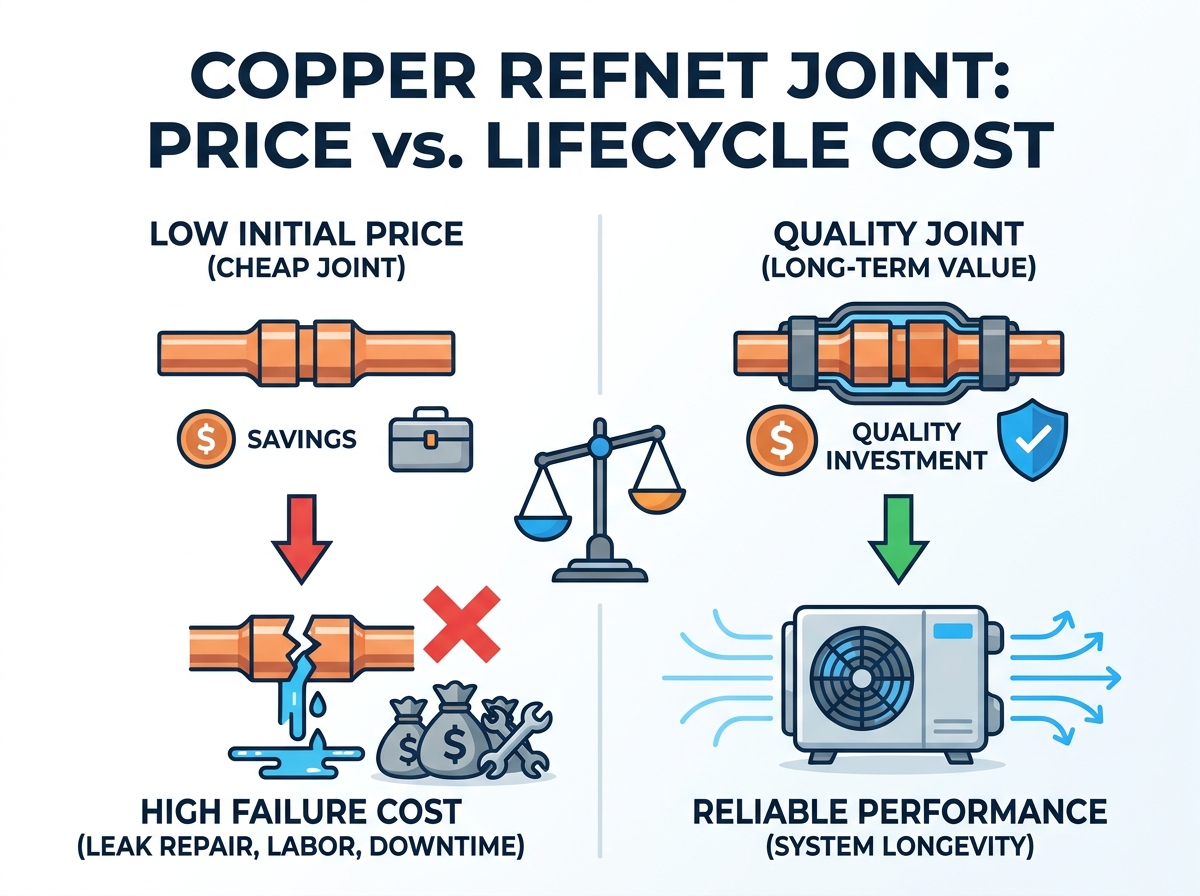
Several underlying factors dictate why pricing fluctuates between different suppliers. Understanding these drivers prevents you from overpaying. It also helps you spot dangerously cheap, low-quality components before they reach your job site.
Global copper commodity prices directly impact supplier quotes. Copper trades actively on international exchanges. When mining outputs drop or industrial demand surges, raw material costs spike. Manufacturers pass these increases onto buyers immediately. This volatility explains why fabricators typically limit quote validity to short windows. You should always monitor broad market trends before locking in large orders.
Modern HVAC systems demand durable components. High-pressure refrigerants like R410A and R32 push older pipe designs to their breaking points. Operating pressures often exceed 400 psi during peak summer loads. Consequently, safety codes require thicker copper walls. Fabricating a thicker joint consumes more premium C12200 grade copper. This directly increases material costs. However, investing in adequate thickness ensures safety compliance and actively prevents catastrophic ruptures.
The method used to build the branch matters immensely. Premium suppliers utilize automated CNC machining. They rely on robotic factory welding for assembly. These advanced techniques guarantee precise dimensional accuracy. Every branching angle stays perfect. This ensures equal refrigerant distribution across the system. Manually brazed joints cost less to produce, but they carry higher defect rates. Cheap manual joints often restrict flow or leak under pressure.
Refrigerant lines sweat aggressively. Condensation drips ruin drywall and ceiling tiles rapidly. To prevent this, every branching connection requires heavy insulation. Premium quotes usually include custom-molded, fire-retardant EPDM insulation covers. These parts fit the joint perfectly. Quotes including these covers inherently cost more upfront. However, they save tremendous field labor. Technicians simply snap the molded cover into place instead of cutting and taping flat foam for hours.
The most polarizing debate in HVAC procurement centers on sourcing. Do you pay top dollar for brand-name components, or do you leverage specialized third-party alternatives? Both paths offer distinct benefits and specific risks.
Genuine brand-name joints from companies like Daikin, Mitsubishi, and LG carry a hefty price premium. You generally pay 30% to 50% more for an OEM label. This premium buys absolute brand assurance. The manufacturer guarantees perfect system compatibility. Engineers often specify OEM parts exclusively to avoid any compatibility arguments during commissioning. If you have a massive budget, OEM parts offer peace of mind.
Specialized third-party manufacturers focus entirely on producing copper fittings. They supply the global market efficiently. Because they do not carry the massive overhead of building entire VRF systems, they offer steep cost savings. Quality aftermarket manufacturers produce components matching OEM specifications perfectly. They provide exceptional value, provided they meet strict industrial standards. Many top-tier aftermarket factories actually manufacture the components for major HVAC brands behind the scenes.
You cannot buy aftermarket parts blindly. You must vet them rigorously to protect your installation. Use the following criteria to evaluate non-OEM suppliers:
Sticker price paints an incomplete picture. The raw component only represents a starting point. Smart estimators analyze the full installation burden. Budgeting accurately requires looking at labor, materials, and long-term reliability.
Installing branching pipes demands highly skilled labor. Technicians must perform nitrogen-purged brazing. They flow inert nitrogen gas through the pipes during welding to prevent interior oxidation. This process requires time, specialized training, and expensive silver brazing rods. The cumulative cost of field labor and premium filler metals often exceeds the purchase price of the Copper Refnet Joint itself. Buying cheap joints that fit poorly wastes expensive technician hours.
Never underestimate insulation labor. If you buy a bare joint, your crew must manually measure, cut, and glue standard foam around complex angles. Wrapping a single joint manually takes considerable time. Multiplied across fifty floors, this manual labor destroys your schedule. Pre-molded insulation eliminates this bottleneck completely. Paying slightly more for included molded covers always yields a positive return on investment in the field.
You must weigh upfront savings against potential catastrophe. Saving $20 on a cheap, thin-walled joint seems smart during procurement. However, if that joint ruptures behind a finished ceiling, the financial fallout is immense. You face the cost of locating the micro-leak. You must pay for complete refrigerant recovery. Your team has to cut open the drywall, replace the fitting, pull a deep vacuum, and recharge the system with expensive gas. A $20 savings quickly transforms into a $2,000+ emergency repair bill.
Moving from planning to purchasing requires discipline. Do not simply award the contract to the lowest bidder. You need a structured approach to evaluate incoming proposals.
Budgeting for a copper refnet joint requires looking far beyond the initial sticker price. You must account for material quality, installation efficiency, and long-term reliability. A cheap fitting saves pennies today but risks thousands in future emergency repairs. Raw material volatility, wall thickness requirements, and manufacturing precision all shape your final invoice.
We strongly recommend prioritizing suppliers who offer complete transparency. Choose partners who provide verifiable pressure testing documentation and include pre-molded insulation. Evaluating aftermarket options carefully against OEM brands can unlock substantial budget savings without sacrificing safety. Taking these deliberate steps protects your project margin, accelerates installation, and ensures the ultimate lifespan of your client's HVAC system.
A: Standard fittings simply connect pipes. Refnet joints feature highly specialized engineering. They utilize precise branching angles designed to guarantee equal refrigerant distribution across complex networks. Manufacturers must use thicker copper walls and employ advanced robotic factory welding processes to withstand extreme pressures.
A: It varies heavily by supplier. Premium OEM quotes usually bundle custom-molded, fire-retardant insulation covers. Budget aftermarket suppliers often sell the bare copper fitting alone to show a lower price. You must explicitly check your quote to see if insulation is included.
A: No. Standard T-joints create uneven refrigerant flow and severe turbulence. This leads to intense system noise, poor cooling performance, and eventual compressor failure. T-joints are technically unacceptable substitutes in any modern VRF or VRV installation.
A: Global copper commodity prices shift daily. Because these components rely entirely on raw copper, fabricators adjust prices constantly. Most supplier quotes carry a validity period of just 15 to 30 days due to these raw material fluctuations.


