
Views: 0 Author: Site Editor Publish Time: 2026-11-26 Origin: Site
Designing a modern Variable Refrigerant Flow (VRF) or Variable Refrigerant Volume (VRV) system presents a distinct engineering hurdle. You must maintain uniform refrigerant volume and pressure across multiple indoor units spread throughout a building. Failing to manage this flow creates significant performance bottlenecks.
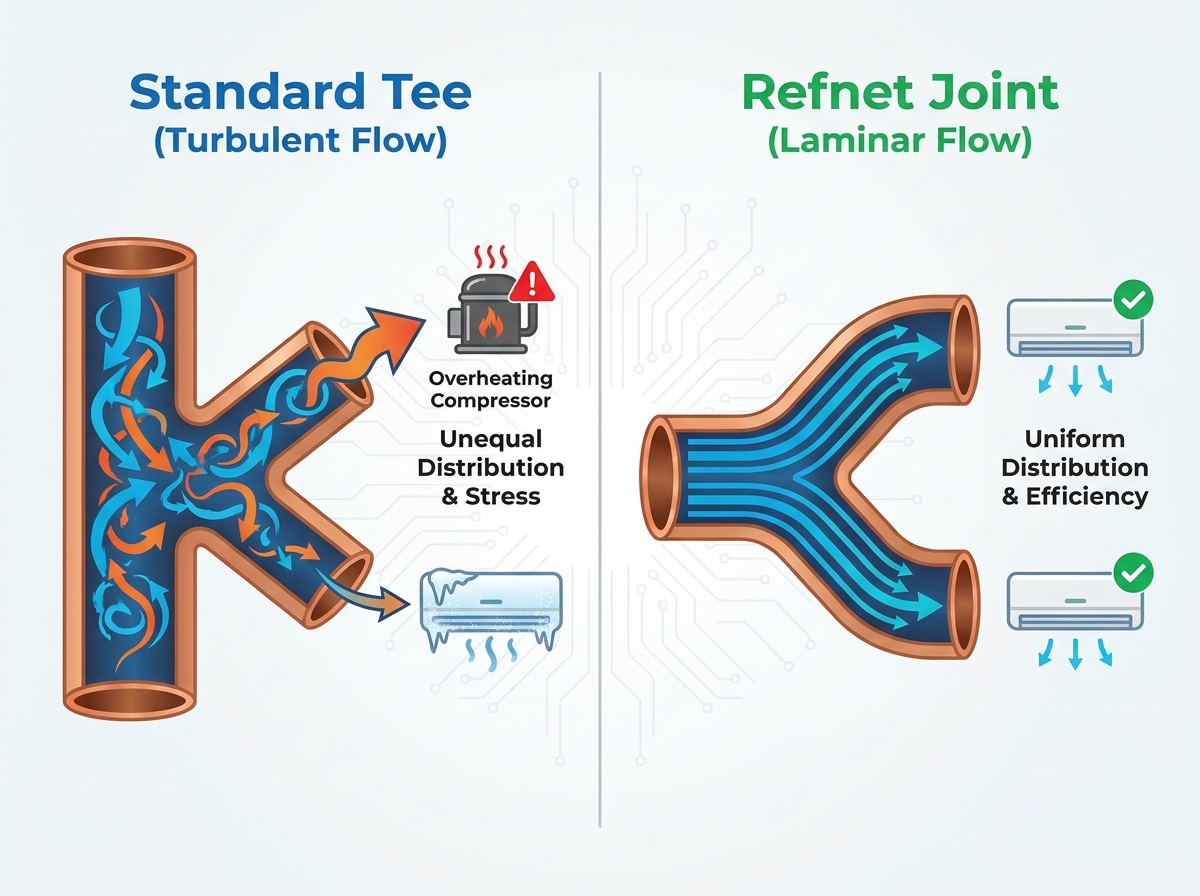
A Copper Refnet Joint serves as the engineered branching component designed specifically to solve this distribution problem. It prevents unequal refrigerant splitting, safeguarding your compressor from premature burnout. Standard plumbing fittings simply cannot handle the intense pressure dynamics of modern refrigerants.
This article provides HVAC engineers, project managers, and procurement teams a clear evaluation framework. We will explore the critical features, operational benefits, and installation realities of these essential components. You will learn exactly how to specify and source the right branching joints for your next commercial project.
Multi-zone HVAC networks face a severe business problem regarding fluid dynamics. Imbalanced refrigerant flow severely disrupts system efficiency. It causes localized freezing in starved terminal units. Conversely, overfed units can send liquid refrigerant back to the compressor. This liquid slugging often leads to catastrophic compressor burnout.
Refrigerant travels through the piping network in a mixed state. It contains both liquid and gas phases. These phases behave differently when navigating corners and branches. Heavier liquid tends to carry forward using its own momentum. Lighter gas easily diverges into side branches. This physical reality makes simple branching impossible for complex VRF systems.
The engineered solution relies on specific geometries. A Refnet (Refrigerant Network) joint uses a specialized Y-shape or header design. This geometry forces the liquid and gas to mix evenly just before the split. It then divides the mixture proportionally. The refrigerant splits evenly regardless of the distance to the terminal units.
You might wonder why standard plumbing tees fail here. Standard copper tees create severe turbulent flow under high-pressure HVAC applications. They cause unacceptable pressure drops. The sharp 90-degree angles destroy the delicate balance of liquid and gas phases.
Using standard tees voids most equipment warranties. Original Equipment Manufacturers (OEMs) mandate compliant Refnets to ensure predictable system performance. The table below illustrates the stark differences between these two components.
Table 1: Performance Comparison: Standard Tees vs. Refnet Joints
| Component Feature | Standard Copper Tee | Copper Refnet Joint |
|---|---|---|
| Flow Dynamics | Turbulent, unpredictable separation | Laminar, proportional separation |
| Phase Management | Separates liquid and gas poorly | Maintains liquid/gas homogeneity |
| Pressure Drop | High (forces compressor overexertion) | Minimal (optimizes efficiency) |
| Warranty Status | Voids OEM system warranty | Mandatory for warranty retention |
Not all branching joints offer the same reliability. You must inspect several manufacturing details before specifying them for commercial projects. Material science plays a dominant role here.
Material grade and purity dictate long-term performance. You must specify phosphorus-deoxidized copper. The industry standard designates this as Cu-DHP or C12200 copper. This specific alloy provides optimal brazing characteristics. It resists hydrogen embrittlement during high-temperature welding. It also offers superior corrosion resistance against internal refrigerant chemical reactions.
Wall thickness directly correlates to pressure ratings. Modern refrigerants like R410A and R32 operate at exceptionally high pressures. System pressures often exceed 600 psi during peak heating cycles. Wall thickness must align perfectly with these operating pressures. Substandard thickness invites micro-leaks or catastrophic ruptures.
Precision brazing separates premium joints from budget alternatives. Factory-level manufacturing utilizes automated, silver-alloy brazing. This controlled environment ensures consistent joint integrity. Automated brazing prevents excessive flux application. Excess flux can contaminate the internal piping network and damage sensitive valves.
High-quality joints also feature pre-formed insulation kits. Standard pipe insulation rarely fits the complex geometry of a Y-branch. Manufacturers provide perfectly fitted, flame-retardant insulation shells. This custom fit prevents surface condensation. It also halts thermal loss into the surrounding ceiling void.
To evaluate a commercial-grade Copper Refnet Joint, review these critical specifications:
Investing in premium branching joints yields measurable operational returns. These components sit hidden behind ceilings, but they heavily influence daily building operations. They deliver benefits across three distinct categories: efficiency, safety, and longevity.
Optimized system efficiency begins at the branches. Smooth internal geometries minimize the pressure drop across the joint. When refrigerant flows smoothly, the main compressor performs less work. Reduced compressor workload translates directly into lower electrical consumption.
We can break down this efficiency preservation into sequential steps:
Enhanced operational safety provides peace of mind for facility managers. Well-manufactured joints boast incredibly high burst-pressure thresholds. They undergo rigorous factory testing. These tests ensure the safety margins sit well above standard operating parameters. A system pressure spike will not cause a properly specified joint to fail.
Lifecycle durability represents the final operational benefit. Pure copper offers remarkable structural integrity. When combined with proper insulation, these joints resist environmental degradation. This synergy leads to decades of maintenance-free operation. You can essentially install them and forget them, provided the initial installation meets strict guidelines.
Procuring excellent components solves only half the equation. Field installation introduces significant risk factors. Proper installation remains just as critical as manufacturing quality. Installers must follow rigid protocols to avoid compromising the entire VRF network.
Orientation restrictions dictate field layouts. Refnet joints demand strict spatial alignment. Installers must place them either perfectly horizontal or perfectly vertical. Horizontal installations allow a minor tolerance of ±15 degrees.
Fluid dynamics dictate this rigid rule. If an installer tilts a horizontal joint by 30 degrees, gravity takes over. The heavier liquid refrigerant pools into the downward-facing branch. The upward-facing branch starves, receiving mostly gas. This ruins the engineered split and severely impacts cooling performance.
Nitrogen purging during field brazing stands as an absolute necessity. Copper reacts violently to oxygen when heated by a brazing torch. It forms cupric oxide scale on the interior pipe walls. This black, flaky residue peels off once the refrigerant flows.
These flakes travel rapidly through the system. They inevitably reach the electronic expansion valves (EEVs). The scale clogs the fine mesh filters protecting these valves. Flowing inert nitrogen gas through the lines during brazing pushes oxygen out. This entirely prevents internal oxidation.
Sizing and cutting errors represent another common field failure. Refnet joints feature stepped ends to accommodate various pipe diameters. Installers must cut these stepped ends precisely. They must match the incoming and outgoing pipe sizes mapped on the engineering drawings.
Using improper tools crushes or warps the copper tubing. Installers should use sharp, calibrated pipe cutters. A deformed cut creates gaps during brazing. These gaps require excessive filler metal, increasing the risk of internal blockage and future leaks.
Selecting a reliable supplier prevents delays and ensures system compliance. Procurement teams must look beyond initial pricing. You need a supplier capable of supporting complex commercial timelines and strict OEM requirements.
OEM compatibility serves as your primary filtering criteria. VRF manufacturers design their proprietary software around specific pressure drop coefficients. Sourcing generic joints invalidates these software calculations. You must verify the supplier matches specific brand flow dynamics. Look for verified compatibility for systems like Daikin VRV, LG Multi V, or Midea V6.
Compliance and certifications establish a baseline of trust. Advise your buyers to request documentation. You want to see ISO 9001 manufacturing standards. RoHS compliance ensures no hazardous materials contaminate the build. Third-party pressure testing documentation proves the supplier verifies their safety claims.
Supply chain stability and lead times directly impact project schedules. Evaluate suppliers based on inventory depth. Investigate their packaging quality. The thin, stepped ends of a branching joint suffer damage easily during transit. Flimsy cardboard boxes result in crushed fittings arriving on-site. Finally, assess their technical support. A responsive supplier helps resolve complex sizing calculations quickly.
Table 2: Supplier Evaluation Checklist
| Evaluation Criteria | What to Verify | Why It Matters |
|---|---|---|
| Brand Compatibility | OEM-specific internal geometries | Ensures system design software remains accurate. |
| Quality Certifications | ISO 9001, RoHS, ASTM compliance | Guarantees consistent manufacturing and material purity. |
| Packaging Standards | Rigid boxing, individual component wrapping | Prevents deformed pipe ends during international shipping. |
| Technical Support | Availability of sizing charts and engineering data | Accelerates field troubleshooting and ordering accuracy. |
Copper Refnet Joints represent a minuscule fraction of a VRF system's total material budget. However, they carry disproportionate responsibility for overall system reliability. A single failed branch can cripple multiple indoor units or destroy a costly compressor.
Procurement teams and engineers must prioritize material specifications over minor cost savings. Exact OEM compatibility and high-purity copper ensure long-term performance. You must also enforce strict installation protocols regarding orientation and nitrogen purging.
Take action on your next project by reviewing your current piping specifications. Consult the technical specification sheets provided by your VRF manufacturer. Contact a specialized component supplier to request accurate sizing charts and project-specific quotes today. Protect your HVAC investment by building it on a reliable piping foundation.
A: No. While the underlying physics are similar, different OEMs require specific internal geometries and sizing charts. Always match the joint specification to the equipment manufacturer.
A: Absolutely not. Standard tees create turbulent flow, causing unequal distribution of refrigerant liquid and gas, leading to poor cooling performance and potential equipment failure.
A: Sizing is dictated by the total cooling capacity index of the indoor units connected downstream of the specific joint, usually calculated by the OEM's system design software.
A: Yes, commercial building codes typically require the accompanying insulation to meet specific flame spread and smoke development ratings (e.g., ASTM E84).


